
This article is part of the Self-Love hub, a single thread within the broader practice of inner work.
Read more from this hub →
“Be the love you never received.” “Fall in love with yourself first.” “Treat yourself like someone you love.”
Umm okay. Thanks. But how the f*ck do you do that?
Putting my desire to cuss profusely aside (it’s an Australian urge, so don’t blame me), I want to give a voice to something I don’t see spoken about enough in the healing field:

Soul Work Compass Course:
Feeling lost, stuck, and trapped in repetitive cycles of pain? Discover your Soul's Compass to reclaim your purpose and find your path to freedom.
⭐️⭐️⭐️⭐️⭐️ "I have been a long-time subscriber to their website, and it’s one of my favorites by far ... It is rare to find this type of teacher." – Shar B.
How self-love can be used as a covert self-shaming tactic.
Being loving towards myself is something I’ve been struggling with a lot at the moment. The combination of stress from multiple areas of life (family, business, societal, and just life shit in general) has put this inner work healing path to the test.
Like vultures that have been circling above me, irritability, stress, and the threat of burnout have been my companions for many months now. Call it the existential threat of AI to livelihoods like my own, mixed with caring for an emotionally volatile toddler, and extended family drama – whatever the case, things have been difficult.
Thankfully, I have a robust inner work and soul recovery practice to fall back upon in times like these – one that has been forged through years of trial, error, and breakthrough. A path that can hold me in times of need, even when there aren’t many others I can turn to.
But I realize that not everyone has a mature self-love practice. Not everyone knows how to show compassion to themselves in times of stress and overwhelm. Perhaps you’re one of those people.
If you are, here’s what I’ve learned about how to avoid drowning in the “dark side” of self-love. Because, yes, it can be used as a way of ironically hurting yourself even more if you aren’t careful.
Table of contents
When “Love Yourself” Becomes Another Way to Fail

Firstly, let me say that self-love, genuine heart-centered self-love, is deeply healing. It is the bedrock of inner work. There’s a reason why everyone from self-help gurus to spiritual teachers and clinical psychologists recommend it.
Self-love provides a stable foundation for everything else in your life. Want a better relationship with others? Learn to love yourself. Want to live a meaningful, purpose-driven life? Learn to love yourself. You get the picture.
Want to get LonerWolf at the top of your Google search results?
But there’s a difference between heart-centered self-love and mind-centered self-love. One comes from a place of compassion. The other comes from a place of ego – of dualistic thinking. One heals. The other destroys.
Self-love becomes weaponized when we use it as a yardstick to measure how “evolved” or “healed” we have become.
What part of us does this? Usually, it’s the inner critic – that part of our psyche that negatively judges how we look, what we think or feel, and how we behave.
Some signs that your inner critic has weaponized self-love include thoughts like this:
- “I shouldn’t have judged myself so harshly; I always do that. What’s wrong with me?”
- “I should have been more loving towards myself. I failed, again.”
- “I have to be 100% self-loving all the time.”
- “I have so many negative thoughts about myself. I can’t seem to love myself. I must be broken.”
- “Well, ____ knows how to be self-loving. But I just can’t seem to do it.”
- “That old pattern came up again. I judged myself negatively for the 1000th time. I’m a failure.”
- “I’m not healed or self-loving enough yet.”
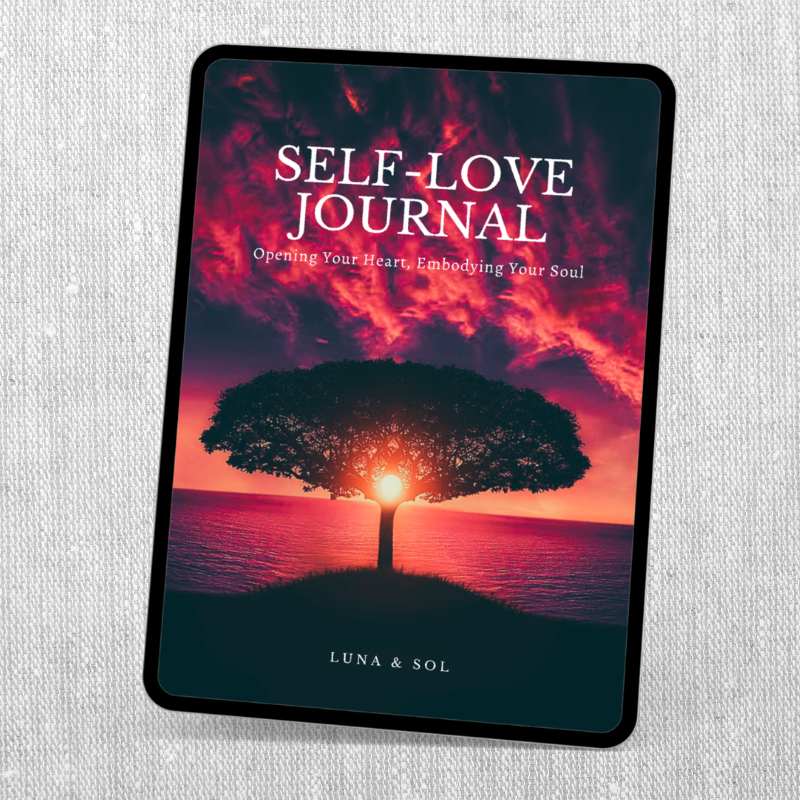
When I catch my own mind looping through these meta-judgments, I’ve learned that the only way out is to get those thoughts out of my head and onto paper. (In fact, tracking these exact thought-loops is a core part of the Self-Love Journal).
You might notice a pattern here: judging our judgments. Rejecting our acts of rejection. Feeling angry at our feelings of anger.
This gets very “meta” and reminds me of the movie Inception: dreams within dreams within dreams.
The Hidden Cruelty of “Just Love Yourself”

Moving from a state of self-loathing to self-love doesn’t just happen like that. This is something I’ve learned the hard way, and a truth almost nobody talks about.
It happens via a series of slow steps. And it’s common to take two steps forward and one step back. There is no linear process. There is no “just love yourself.” That’s a cruel thing to say to someone stuck in the quagmire of self-loathing.
The journey of self-love looks more like this:
Would you like to save this?
Your information will never be shared.
- Stage 1: Self-loathing
- Stage 2: Self-dislike
- Stage 3: Self-tolerance
- Stage 4: Self-like
- Stage 5: Self-understanding
- Stage 6: Self-acceptance
- Stage 7: Self-kindness
- Stage 8: Self-love
- Stage 9: Self-compassion
This path of inner work happens in degrees. And this can only happen through a slow commitment to getting to know our hearts and minds.
Navigating these stages alone can feel incredibly isolating. If you find yourself needing a safe, quiet space to process this without the pressure to ‘just be happy,’ I poured my heart into structuring the Self-Love Journal. It’s designed to be a gentle, step-by-step companion on the days when self-compassion feels impossible.
The Covert Shame Inside Modern Self-Love Advice

My core wound is shame, and so whenever I hear shaming language, the red-eyed feral wolf within me raises its hackles and howls hysterically to the wind. But no, really, there is a lot of shaming self-love advice out there.
Take this as a prime example from author Gary Zukav. I’m not necessarily a die-hard fan of his work, but I do appreciate his contributions to the world. This isn’t an attack on him as a person, as I think he’s a great guy, just a critique of this passage in his famous book Seat of the Soul,
“If you cannot love yourself, you cannot love others and you cannot stand to see others loved.”
This is a popular quote on social media, and heck, I think I’ve even reposted it once upon a time. But when you stop and really examine this quote, you can see that it reeks of covert shame.
I get the gist of it: that trouble loving yourself means that you will struggle to love others fully because you’ll be seeking that love in them rather than in yourself. It can lead to codependency and all that jazz.
But honestly, things are not so black and white. Can someone who doesn’t love themselves love another? Is that even possible? Yes. I think it is. A mother or father who struggles with low self-worth can absolutely love their child. A person who is critical of themselves can certainly give love to their partner, friends, or family members.
Is that love free of enmeshment, codependency, and other inner issues? No, probably not. But it doesn’t mean that they cannot love them, as Zukav seems to suggest in that passage.
I won’t even touch on the second part of that quote (“…and can’t stand to see others loved”) because it follows the same logic.
Then there are self-help and spiritual gurus out there teaching us about self-love by conflating it with buying Mazzeratis, getting boob jobs, and treating themselves to retail therapy … which … don’t even get me started on that and the covert shame it can induce in those who don’t have the means to do likewise.
For over 15 years, we've strived to make this website a haven of free, valuable information. Imagine a world where this knowledge wasn't readily available.
If this post sparked a meaningful insight or helped you in any way, please consider a donation as a heartfelt "thank you" for keeping this resource free.
Every contribution, big or small, allows us to keep giving back.
 Yes, I'd Like to Help
What Authentic Self-Love Looks Like (Minus the Shame)

I’ve had to be very careful when it comes to topics like self-love in my own practice, because my inner critic is humongous. It will grab onto anything – a look, a word, a concept – and use it to feed into my core wound of shame.
That is the hidden trap of words like “self-love.” They look warm, fuzzy, and gentle on the surface, but these same qualities also make them prime targets for the ego to take and weaponize.
This corruption of the idea of self-love reminds me of those sneaky weeds you see in the garden, camouflaged so well you wouldn’t notice them without squinting. They disguise themselves as their host plant, and if you don’t uproot them, they end up eventually becoming monstrous usurpers of your garden.
So let’s not let that happen with bogus shame-inducing self-love.
“How do we do this?” you might wonder. There are two techniques I have. The first I call the Fractal Self-Love practice (because hey, I enjoy coining terms).
Fractals are infinitely repeating patterns. They look the same at any level of magnification.
This is how the Fractal Self-Love practice works:
- Love your inability to love.
- Accept your non-acceptance.
- Embrace your tendency to not embrace.
Essentially, apply love to even the most unlovable states, emotions, and tendencies. Apply love as the self-healing balm to all inner states of crisis. This technique requires connecting with the heart, which I’m aware not everyone has access to. But if it calls to you, try it out.
For example, the next time you find yourself judging your lack of self-love, see if you can connect with your heart and love the one that struggles to practice self-love.
The second technique is Divine Inner Parent practice.



Essentially, notice that all angry, judgmental, and self-critical parts in you are actually scared inner children or lost teenagers that just want to be reassured that everything is okay. That they are okay. The voices of self-hatred and shame within you come from these younger inner parts, and the last thing they need is rejection. What they truly need is to be embraced by loving energy, or what I call the Divine Inner Parent. Although I’m not Catholic, I have a statue of the Virgin Mary in my house as a symbol of this energy.
If you struggle to remember these practices in the heat of the moment, I’ve found that externalizing these voices onto paper is one of the most effective ways to break the spell of the inner critic. For those who want a guided space to practice this kind of shadow integration, I’ve included specific prompts for this exact work inside the Self-Love Journal.
***
Self-love is a deeply transformative and life-changing practice. But it can be appropriated by the ego to reinforce a sense of shame and isolation.
If something stinks of mind-centered self-love, please trust yourself.
You don’t need to accept what the world teaches you about self-love unless it aligns with your own soul’s deepest wisdom. Only you can walk your path, and only you know what is truly nourishing or not.
That’s it for now.
Tell me, what does corrupted self-love look like? What are the signs to watch out for? I’d love to hear in the comments.
Whenever you feel the call, there are 2 ways I can help you:
1. The Soul Work Compass Course: Ready for deep transformation without the fluff? The Soul Work Compass provides a step-by-step path to finding your inner truth and life direction. Heal core wounds, clarify your values, and walk away with a concrete guide for living. Get started now!
2. The Inner Work Journal Bundle: Stop surface-level healing. Dive into the depths with 150+ journaling prompts designed to help you face your demons, heal childhood wounds, and embrace your shadow. Three sacred journals, lifetime access, print as many times as you need. Real transformation starts here.
Your advise is so true and filled with words of wisdom. Follow your own advise, wisdom and intuition with raising your own child. The message was so true. Listen to the soft music that plays with you and your soul as you for you and your child.
Blessings and gratitude Sally Jane
Thank you Sally Jane. Lots of love 💜
Very interesting perspective!
Especially the monetised/ materialised kind of self-love is very popular and although I admit that it sometimes makes you feel better, this isn’t always the case. I mean that sometimes you DON’T need a bubble bath, new underwear, a vibrator or a new hairdo. You may not even need a partner, more money, or an expensive cruise somewhere in the world… In a way, although the self-help gurus talk about self-love coming from inside, they end up preaching that self-love depends on things outside of us. Things that we (don’t) own. Things that we can’t control.
I believe that it can be a good place to start, maybe/ sometimes. The material world is more easily understandable. But this is definitely not the end- although it is often presented as if it is. (Or even worse it is presented as if self-love is a synonym to material success. “If you really DID love yourself, you would DEFINITELY have a good job, money, a partner, kids, great body, amazing sex life, a very spectacular spiritual practice with a very famous guru, whatever…” Yep, another reason to feel awful about yourself, because most of us don’t live such lives, or are genuinely NOT interested in doing so…)
Honestly, keep up with the good work!
Your articles are true food for thought!
Lots of love from Greece!
OMG, so timely. I’ve been dealing with some absolutely crazy, insane sh*t from my local Building Dept. about a deck replacement that is *2 INCHES* too big for my property—even though it is 2 feet SMALLER than the deck it replaced.
To say that I have been feeling anger over the situation is the understatement of the month.
But what I finally concluded today is that “loving myself” means loving the TRUTH of myself. And since I can’t make myself NOT angry over the situation, no matter how much I would like to (I HATE feeling angry), that means loving my anger. So that is what I have chosen to do.
I should have pointed out that the issue resulted from a spiteful neighbor couple who ratted me out to the Building Dept. for not having a permit (I had no idea that you needed a permit to repair and rebuild an old, already-permitted structure) because they were pissed that I didn’t hire the husband to do the work. I’ve already spent thousands of dollars (on top of the construction costs) to try to regularize the situation, and it looks like I might have to spend thousands more to get a “variance” for the work. All in all, it’s been a pretty rough month. And I will NEVER hire my neighbor again, even though I’ve been a good customer of theirs for years.
Kristen Neff”s book on Self Compassion is questionable at best. I’ve found your research and writings/teachings much deeper and applicable. Neff focuses heavily on being kind to yourself after things go wrong. Real self-love focuses on protecting yourself before things go wrong by setting firm boundaries. The difference between her teachings and yours respectively i sum up (i may be wrong) as: toxic self-compassion is a sponge—it just tries to soak up and wipe away your bad feelings. Real self-love is a muscle—it requires effort, boundaries, and accountability, but it actually makes you strong enough to handle reality.
Neff’s Self-Compassion is Self-Centricity.
That’s a unique perspective, Ali. Thanks for sharing. I’m aware of Neff’s work, but haven’t gone too deeply into it, so I’m not sure precisely what she teaches. What I do know is that there is a yin and yang to self-love. The yin is soft and sweet. But the yang is often ignored, and that is the capacity to set boundaries and protect yourself when necessary. Both are needed; otherwise, we become simpering doormats for others to step on.
Aletheia, right now for me, your greatest gift is your honesty about the struggle. I believe I have all the information I need, but it’s the struggle to get it all together, to get it down, that troubles me. Hearing you face similar struggles helps me push thru and keep going. Your honesty about the ugly parts is so valuable to me.
Thank you
Carol
Thank you for voicing this, Carol. It’s so helpful to remember that we’re all human and we all experience struggles. Yes, we have a Divine core, but that doesn’t negate the difficult realities of daily existence. Hang in there 💜
I believe self-love is a way to protect myself, as well. I don’t see it as being selfish. I come from a big family, and there was a lot of stuff going on around me all the time with tons of noise. I am an introvert by necessity. I see it as a self-loving and protective aspect of my personality.
“I see it as a self-loving and protective aspect of my personality.” – yes, absolutely essential for a life well-lived. Thank you for sharing, Angela. ;)
Dear Aletheia,
It’s been a while. I realise I have to be sensible about what I publish on this platform, so I will refrain from the temptation to cut and paste my email to UK Samaritans last night. They used to have an email service but my late-night confession was greeted by a ping back to the effect that that service has stopped.
Again, as I am aware many other readers will scan through these words I’ll attempt clarity and brevity. Things are not good. I have been retired since March it took me a long time to tear myself away from the boss praise co-dependency thing. Took me a few weeks to get over the boss loss and I booked many trips to my native South of France to try and patch up the thing you call “Domicide” which now more than ever tears at my soul, trapped between two countries as my body ages and wilts and uglifies, something I tried to prepare for but in reality there is very little that can prepare you for that. So listen to me folks: “Strap yourselves up, it’s not good”
To cut a long story short just as I was coming up for air my next-door neighbour who has mental health issues (the kind that is recorded, acknowledged and protected) went berserk and tried to break into my house repeatedly. The police and the authorities have decided there will be no repercussions due to her mental health issues. My own mental health issues on the contrary, because I never reported, recorded or asked protection for, continue to remain undetected. And so in my old age I barricade myself in my own home at night.
Just to finish on a positive note: I have a cheery bright twinkly memory of my birthday last year, which is very close to your birthday Aletheia. I was holidaying in my beloved South of France. On my birthday there were not many wishes from good old Blighty but there was one from you guys. You emailed that you mentioned to Matteo: “It’s Marie-France’s birthday today” You two!… From the other side of the planet!.. Technology does carry miracles if only we put the correct intention behind it.
Not sure where the connection with today’s theme is. But it is there somewhere.
Lots of love,
Marie-France 💗
Hi Marie-France,
It’s lovely to hear from you again. And I’m sorry to hear of that distressing encounter with your next-door neighbor – what a stressful ordeal! Perhaps if it’s possible, get a guard dog – or if circumstances allow, move to a new location. In any case I hope you find some peace.
Sending love for your birthday and wishing you relaxation and joy 💜
Aletheia
Thank you and to you too Aletheia 💗
thank you,
this resonates deeply for me.
This has been most inspiring.
Thank you Kay 💜
Find quiet and unwavering trust in your self.
Allow shame, guilt and self criticism along with every other emotions.
Act accordingly but do allow yourself to be human.
If you must, judge yourself as long as it betters you but know that no amount of self help/work/religion or spirituality can ever make you non human or understand your own complexity.
Forgive, let pass… Live first and foremost… be.
“know that no amount of self help/work/religion or spirituality can ever make you non human or understand your own complexity.” –– well said Tobias!
Such a timely and necessary topic! The whole idea of self-love is super important, but it can also be kinda tricky. We all have our narcissistic tendencies — every single one of us. The problem is when we blow that part of our psyche out of proportion — stepping away from the balanced middle path — until we basically fall in love with ourselves to the point of ignoring our vulnerabilities and disconnecting from our true Self. See, passion is different from love: passion blinds and alienates. Love, on the other hand — and that’s what we’re really talking about here — is unconditional acceptance, even of the parts of us that aren’t so pleasant or appreciated by others, and that’s totally fine. Real love is surrendering to life’s inner wisdom, whether circumstances feel ‘good’ or ‘bad.’ It’s not about silencing our inner critic, but rather accepting it and saying: no need to judge, things happened exactly as they should — not because they were right, but because they were real, and now they are material for our growth. That self-pressure shows up when we’re afraid of messing up — of facing the fact that we’re fully human, that we can handle the pain of disappointing both the outside world and our own inner world. Our worth lies in simply being ourselves, low profile, without needing flashy performances beyond the Self. Self-love, you know, is basically that all-time friend we dream of — but never find, because it’s something you have to call up from within yourself.
“Real love is surrendering to life’s inner wisdom, whether circumstances feel ‘good’ or ‘bad.’ It’s not about silencing our inner critic, but rather accepting it and saying: no need to judge, things happened exactly as they should” – yes, precisely Hans. Thank you for this reflection 💜
Thank you Alethia, very timely, as always, as I have been struggling with my inner critic for some time now, and yes, like you, I have a core wound of Shame.
But, what distresses me most these days is the intrusive thoughts I have, usually violent, towards those that I love, which I’ve had for some time now, but the increasing energies around us is tending to make these more common.
I know this is part of the Shadow side, and I do accept that, but some practical advice on how to ‘deal’ with the thoughts as they come up, would be very much appreciated.
Much love
Marion
X
Hi Marion.
Violent intrusive thoughts are usually due to repressed rage that has been left to fester inside. I recommend finding some safe ways to express that rage via therapeutic art, movement, or some other creative form of self-expression. Hope that helps.
<3
Thank you, that’s interesting. I can relate to that, yes. People often say, too, that its an ‘attachment’, a psychic attack of sorts. But the ‘rage’ thing resonates with me.