
Have you ever felt like a motherless or fatherless child? Have you experienced abuse, betrayal, abandonment, or neglect at the hands of your family members? Do you often feel powerless or overwhelmed by life?
All these are signs that you may be operating from the Orphan archetype – something that many lone wolves and sensitive souls experience.
Of all the shadowy and unconscious inner dynamics we can operate from, this is probably one of the most painful. I should know because I’ve been there, and sometimes, I return there in my darkest moments.
Pain. Emptiness. Aloneness. Fear.

Soul Work Compass Course:
Feeling lost, stuck, and trapped in repetitive cycles of pain? Discover your Soul's Compass to reclaim your purpose and find your path to freedom.
⭐️⭐️⭐️⭐️⭐️ "I have been a long-time subscriber to their website, and it’s one of my favorites by far ... It is rare to find this type of teacher." – Shar B.
These are all the emotional ‘flavors’ of this desolate inner landscape.
Since I’ve become a parent, I’ve again entered this underworld shadow work journey of exploring even deeper layers of my own inner child.
What I’ve realized, in ever more extreme degrees, is that true emotional healing begins when you stop abandoning the orphaned child you once were.
True heart-centered healing begins when you learn to become the parent the orphaned child within you never had.
Table of contents
12 Signs the Orphan Archetype is Ruling Your Life

“The Outcast/Orphan archetype appears in hundreds of folk tales, books of fiction, and even films. Literary characters like Cinderella, the Little Match Girl, Jane Eyre, Frodo Baggins, and Harry Potter are well-known Outcasts … He is the uncomfortable Other, unique and alone in the world, who reminds us how close we all are to being cut loose, to being without support.” – Toko-pa Turner
Before working with the inner Orphan, it’s helpful to know whether this part is dominating your life. Here are some signs to look out for:
- You often feel helpless, powerless, or like a victim (in relationships, work, or life as a whole).
- You have a destructive, cold, or otherwise dysfunctional relationship with your caretakers or family of origin.
- You mistrust others easily and prefer to do things alone.
- You feel like you’re surviving but rarely thriving in life.
- You have a scarcity mindset where you try to hoard resources (money, possessions, food, affection) for fear they will run out.
- You’re self-alienated and struggle to feel a solid sense of identity.
- You tend to adopt the role of martyr or people-pleaser around others.
- You often struggle with feelings of loneliness and emptiness.
- You have a tendency towards addiction (perfectionism, workaholism, drugs, alcohol, social media, etc.) to fill the void.
- You tend to be naive/idealistic and see the world in black or white.
- You struggle to ask for help.
- You are extremely sensitive to any signs of rejection from others.
Healing Begins When You Stop Abandoning the Orphaned Child You Once Were
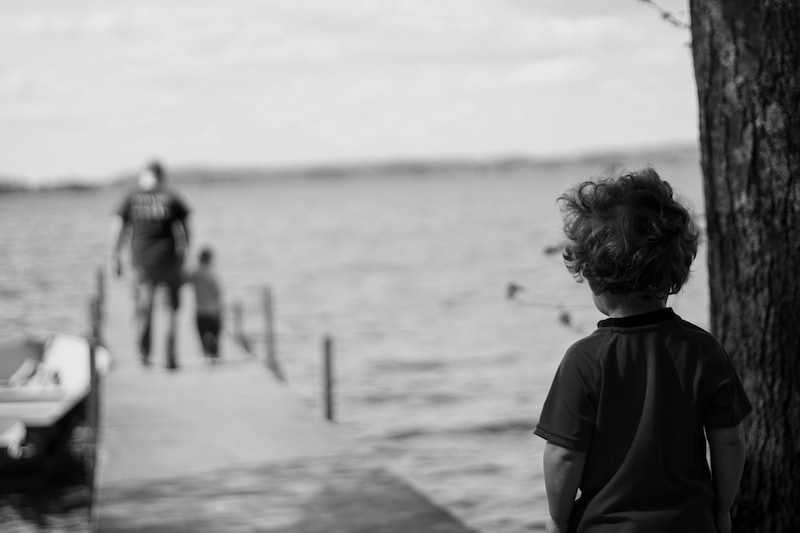
It’s no coincidence that my favorite books as a child were A Series of Unfortunate Events (a book about three orphans), the Harry Potter series (another orphan), and Jane Eyre (yep, you guessed it, another orphan).
Something about these books soothed my soul and gave me the cozy comfort I needed to get through a childhood that felt lonely, scary at times, and imprisoning.
Want to get LonerWolf at the top of your Google search results?
What about you? If you think back to what brought you comfort as a child, do you see any Orphan archetype patterns (e.g., doing things alone, reading about fellow Orphans, or maybe even seeking out all-loving mother or father figures)?
One of the reasons why continuing to operate from this archetype is so destructive is that it keeps us in a state of perceived powerlessness, denial, and victimhood.
Without shifting this energy, we find ourselves stuck in (and in some cases unconsciously seeking out) the same patterns of pain and suffering over and over again.
The first step to healing is to stop abandoning your inner Orphan, to welcome its gifts, and to release its curses.
Where to Start Healing and Finding More Peace

In the words of Carol S. Pearson, PhD., in her book The Hero Within,
“The archetype of the Orphan is a tricky place to be. The Orphan’s task is to move out of innocence and denial and learn that suffering, pain, scarcity, and death are an inevitable part of life. The anger and pain this engenders will be proportional to one’s initial illusions. This Fall leads to realism, because the job of the Orphan is to develop realistic expectations about life.”
As we can see, becoming free from the Orphan archetype and finding more peace first requires us to go through a period of mourning.
We must consciously decide to move out of the innocence, denial, and idealism that haunts our inner Orphans and internally mature by learning to:
- Name and bring loving awareness to how we feel.
- Accept the harder realities of life without collapsing into denial or escapism.
- Practice grief work by facing, mourning, and processing how we feel in the present and what we went through in the past.
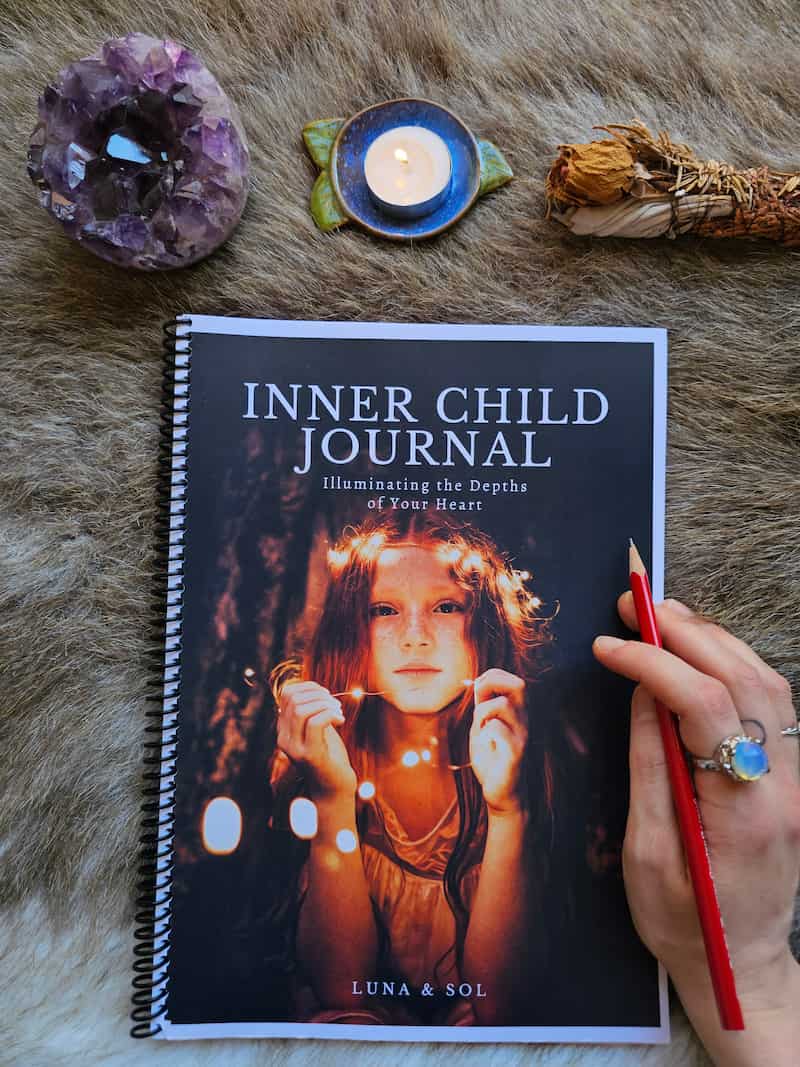
One of my favorite ways to do this is through journaling – something I’ve been doing for more than twenty years now.
It’s this powerful healing practice that I decided to draw upon when I wrote and designed the Inner Child Journal. I paid close attention to helping you develop more internal safety, love, and understanding within the journal, which are essential for reparenting the Orphaned inner child:
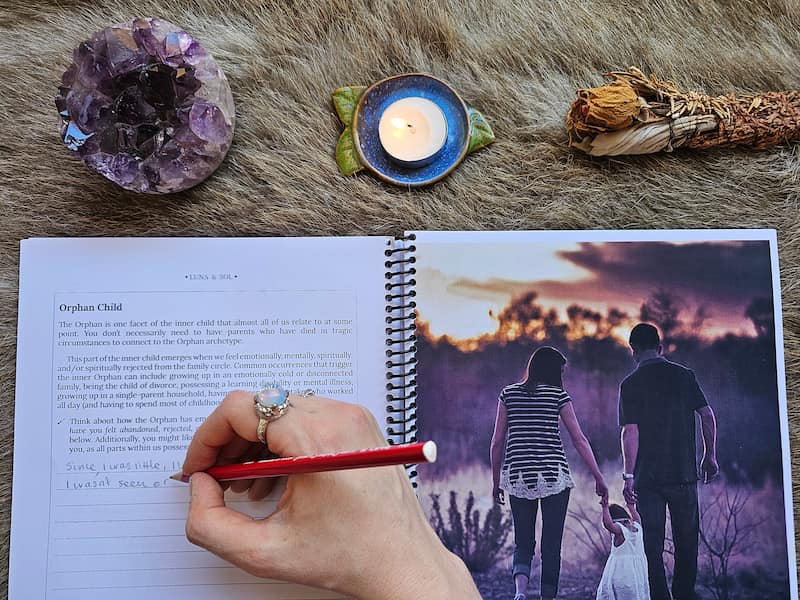
If you need a helping hand, you can get the Inner Child Journal here.
Would you like to save this?
Your information will never be shared.
If you prefer the unguided journaling approach, some simple questions I recommend starting with are:
- “How can I become the parent my inner Orphan never had?”
- “What boundaries in life can I create to help my inner Orphan feel safer?”
- “Deep down, how do I know when it’s time to ask for help?”
As for other methods of grief work, I recommend doing therapeutic art. Drawing, painting, scribbling, and crafting are all powerful ways of channeling and transforming intense and suppressed emotions such as rage, fear, and shame. Mindful meditation is also another way of helping you to stay grounded and present.
Note: If you have gone through severe trauma and struggle to do this work, it may be time to seek out more personal 1:1 help. Ideally, none of us should have to deal with our pain alone. Having a compassionate mirror to witness your pain can help you find the perspective and healing you need to move forward. So if you need someone to truly understand your unique struggles and meet you right where you are, please reach out and get support.*
***
In the words of writer Alice Walker, “Healing begins where the wound was made.” If the wound started as a child, that’s where the healing begins. Learning how to become the parent your Orphaned inner child never had is how to start. May you become that person.
Tell me, were you an ‘orphaned child’ physically, emotionally, or mentally? How has this impacted your life, and what healing path do you plan on taking?
* As a BetterHelp affiliate, we receive compensation from BetterHelp if you purchase products or services through the links provided. Thank you for your patronage. <3
Whenever you feel the call, there are 2 ways I can help you:
1. The Soul Work Compass Course: Ready for deep transformation without the fluff? The Soul Work Compass provides a step-by-step path to finding your inner truth and life direction. Heal core wounds, clarify your values, and walk away with a concrete guide for living. Get started now!
2. The Inner Work Journal Bundle: Stop surface-level healing. Dive into the depths with 150+ journaling prompts designed to help you face your demons, heal childhood wounds, and embrace your shadow. Three sacred journals, lifetime access, print as many times as you need. Real transformation starts here.
Hi,
I had (now estranged) a narcissistic mother and father. It was made clear by my mother and male orientated family that my brothers were accepted, but I wasn’t. I became a workaholic in the NHS. The narcissistic abuse peaked with COVID and work burn out, break down and hospitalised for 3 months with Complex PTSD and chronic anxiety. I am now 48 and just taken on a puppy after years of detachment from everything. I am gradually allowing attachment to the puppy, but find very hard to train the puppy to spend periods alone, due to my own abandonment. Quite an emotional roller coaster xx
Our fur friends are a brilliant and gentle way of reintroducing attachment again. My favorite thing lately has been cuddling on the couch with my two dogs recently. It’s a powerful way of co-regulating and calming the nervous system.
Good Day – I have admired your materials, guidance and courage for a few years. For the past few months I have been getting help with my abandonment trauma associated with my adoption as an infant. I don’t recall acknowledging or associate these events as my being orphaned. However I do identify strongly (a couple very)with 11 out of 12 of the traits listed . . . Thanks 🙏
A deeper dive – more Healing ❤️🩹
Yay . . . he responds sarcastically
Take it easy, slowly, and one step at a time.
Thanks for sharing this Bryan 💜
Oh, and I identify with 10 of the 12 signs.
I’m quite a bit older than you…56. Some of my very favorite books as a kid were “Mandy”, “The Secret Garden”, and The Boxcar Children series, all about orphaned children. I read all of “A Series of Unfortunate Events” and all of Harry Potter to my kids and loved those books, as well.
Appreciate you sharing this, Stefanie!
I connected with 9 of the 12 “signs”… I remember vividly as a child and teenager I jumped around with groups of friends never really getting close or letting them get close to me… I guess I was always on the fringes… I very much enjoy solitude… My fiance and I pretty much keep to ourselves we NEVER invite people over to hangout or for supper… We’re happiest spending time with each other… I always have my defenses up when I’m in a crowd (I try avoiding crowds) or meeting someone for the 1st time and even well after getting to know them…
You mirror a lot of my own experience, Mark. My house is my safe space, and only people I’m almost 100% certain are safe are permitted inside. I think this is part of the healing “cocoon stage” process. Or maybe we’re just a bunch of antisocial introverts. Either way, whatever *shrugs* 😆
When you have this type of wounding, healing is a lifestyle – a journey that is ongoing. I feel more comfortable around unknown folk than I did before, but I still have my hangups. It’s good to know that there are others out there going through this too though.
I was orphaned at the age of 12 and really resonate with these thoughts, even though it was decades ago and I have done a lot of different types of therapeutic work around these issues. Somehow there’s always a deeper layer underneath. I also have an adult daughter who seems to have epigenetically ‘inherited’ this profile. She was terrified of losing me right from a very young age and I see all of the characteristics of the orphan archetype in her and the way she lives. Unfortunately she is not at all receptive to the idea of doing inner healing work at the moment.
I appreciate your courage in opening up about this deep wound, Lalique. When the time is right, I’m sure your daughter will feel called to do her own healing too 💜
As a boy, I had experienced intermittent yet severe physical, emotional and psychological abuse at the hands of my parents, especially my mother.
However, from the outside, they enjoyed plausible deniability through social respectability, especially my mother. They were, therefore, absolutely incorrigible.
I have, therefore, developed an intense, visceral disgust for emotional manipulation and moral grandstanding….. but I know how easy it is for clarity to turn into contempt and self-imposed isolation, because I have felt it myself. I have, for example, often confused tact for manipulation.
Speaking of therapeutic art….. I am a fan of prog metal music, and Dream Theater is the one prog metal band I follow almost religiously. I had discovered them (one of their heavier albums, in fact) during a tough time, and their blend of masterful musicianship and emotional honesty speaks to my soul. I am, in fact, learning the electric guitar myself, something my mother would not have approved of, with her totalising control, including over my artistic expression.
However, I think I beg to differ about idealism. Some of the world’s greatest builders have all been idealists in one way or another. Without idealists, there would be no renewable energy, no Linux, no abolitionist movements, no anti-discrimination movements, no civil liberties, no Internet and no Wikipedia! Come to think of it, doesn’t “generative idealism” originate in someone’s thought that “this isn’t it” and that “there must be something better”?
My rejection of fatalism is particularly strong. I personally don’t believe suffering is the final arbiter, because if it was…. I would not even survive what I experienced, let alone come out still capable of love and tenderness. I am sometimes astonished at myself because of this!
Well, this is my honest take.
Thanks for your honesty and vulnerability, P.A. I used to love Dream Theater back as a teen – then I moved to more ‘goth rock’ like Sisters of Mercy, The Cure, and Type O Negative (which also mirrored how I felt and the angst of being in the midst of constant familial triggering).
As for idealism, it can be a good thing, yes. But like anything, it can also be destructive (rejecting reality, living in denial, dissociative tendencies, dishonesty). So I’m more referring to the ‘shadow’ side of idealism in this post.
I think it’s brilliant you’re taking up the electric guitar – power to you!
Thank you, Aletheia!
Train of Thought marked my entry into the Dream Theater rabbit hole, and songs like Honor Thy Father and In The Name of God almost exactly mirrored how I felt.
I also deeply liked A Change of Seasons, which directly deals with themes discussed in this article, with its mix of soft acoustic passages and intense riff-driven sections across the 20+ minutes of the song.
Lyrics like:
“I remember a time….. my frail virgin mind”
“Oh come, let us adore him….. abuse and then ignore him”
map almost exactly onto topics discussed here!
I’m working on the journal prompts as I type this. The third one is the most challenging:
“How do I know when it’s time to ask for help?”
Having trust issues or sensitivity that comes with rejection that come with the Orphan Archetype, I never know who is appropriate to ask for help. Sometimes we don’t even try to ask because of fear of being criticized if we do, but I ask God/Source for help every day and I know intuitive readers pick up on that, but where is the actual help? Shrug.
Your blog here is helpful. Thank you for that!
Namaste.
Thanks Shelby. Having trust issues and sensitivity surrounding rejection does make asking for help extra tricky. That’s where learning to understand the felt/intuitive sense of safety comes in handy, as in, ‘Does this person feel safe? Do their actions align with their words?’
Very nice writing on the orphan. As usual, insightful writing, deep, reflecting real thought. Thank you.
Thanks Laurel, I appreciate you sharing that 💜
“Healing begins where the wound was made.”
This phrase perfectly illustrates the beginning of the individuation process and, consequently, healing, in Jungian terms. I can say that I was, and still am, an orphaned child—physically, emotionally, and mentally. I constantly need to practice self-awareness, as I have a strong tendency to become overly critical of the present moment—thinking more about how things should be rather than how they are—to seek comfort excessively, and to fall into procrastination, avoiding new experiences and challenges. I also tend to resist opening myself up to new relationships, since negative experiences often make us more rigid and skeptical toward others.
For those who have followed my reflections for some time, it is truly paralyzing when insecurities and lack of self-confidence seem to attract more and more negative experiences into one’s life—especially for those who have carried these burdens since childhood. You watch opportunities slip away, see others moving forward with their lives, while you feel cursed by fate. Yet, as ancient wisdom and spirituality remind us, it is precisely when you feel you’ve hit rock bottom that transformation begins. You realize there is no way out, no one left to turn to, and that change must come from within. At that moment, you begin to seek self-knowledge. And for those, like me, who have been pushed aside in nearly every sphere of life, when it is just you and no one else, you face the most fundamental question: “Should I give up, or should I move forward on my own?” That is the turning point, where courage or fear can determine the course of your life.
As neuroscience explains, we have a strong tendency to seek comfort, and if we do not challenge ourselves—if we do not step out of our comfort zone—we remain forever enslaved by our illusions and idealizations. As Carl Jung said: “Until you make the unconscious conscious, it will direct your life and you will call it fate.” Many of us are accustomed to the pursuit of comfort and pleasure, but life is much more about overcoming—about super-action, that is, action beyond what we are used to in our daily routines. I often say that we must train three muscles: body, mind, and spirit. Only then can we develop true resilience. And make no mistake: it is a continuous and painful exercise, yet at the same time liberating and deeply motivating.
:)
“And for those, like me, who have been pushed aside in nearly every sphere of life, when it is just you and no one else, you face the most fundamental question: “Should I give up, or should I move forward on my own?” That is the turning point, where courage or fear can determine the course of your life.” –– This is the power of the inner lone wolf archetypal force. It fans the embers and helps us to regain strength, resolve, and motivation. I also appreciate how you bring neuroscience into your reflections. Neuroplasticity reminds us that we can grow, evolve, and transform at any age and undo those old limiting patterns. Thank you for your thought-provoking and insightful comment as always, Hans. :)