
This article is part of the Authentic Self hub, a single thread within the broader practice of inner work.
Read more from this hub →
When you first dig up the festering mess of your core beliefs from the depths of your being, you’ll likely experience one of three emotions: excitement, confusion, or grief – or all three at once.
As one of the most fundamental practices on the journey of inner work, uncovering our toxic core beliefs is definitely not a clean or sanitary path.
But it is vital.

Soul Work Compass Course:
Feeling lost, stuck, and trapped in repetitive cycles of pain? Discover your Soul's Compass to reclaim your purpose and find your path to freedom.
⭐️⭐️⭐️⭐️⭐️ "I am finding out so much about myself and having so many realisations about my life ... I already know it is what I’ve needed for so long." – Jen N.
We ALL carry our own devilish assortment of toxic core beliefs that eat away at our sanity on either a conscious or unconscious level. Typically, they influence every level of our being.
To effectively develop self-love, open our hearts to others, experience more inner peace, and live from our authentic self, we need to turn inwards. We need to illuminate the darkness. Going in search of your core beliefs is one of the most essential paths for true and deep healing because it goes to the center of your suffering.
Table of contents
What Are Core Beliefs?

Our core beliefs are the unconscious stories, convictions, and judgments we carry about ourselves that define our sense of self. Core beliefs also determine how we feel about others, how happy we are with ourselves, and how we perceive the world at large.
Our core beliefs are even responsible for how successful we are in self-actualizing our deepest dreams and uncovering our personal meaning of life. In short, our core beliefs influence every aspect of our lives. Typically, our core beliefs first develop in childhood and solidify in adulthood.
Core Beliefs and Spiritual Awakening
We heal ourselves on the mental level as we become aware of our core beliefs, release those that limit us, and open to more supportive ideas and greater understanding.
– Shakti Gawain
The whole point of the healing journey of awakening is to loosen our attachment to that which is false and limiting – and this includes our core beliefs. These core beliefs can become so dense and constricting that they contribute to a Dark Night of the Soul (or spiritual crisis).
In Indian philosophy, core beliefs are related to the idea of samskaras, or patterns of conditioning that we continuously repeat in our lives. To connect with our True Nature, we need to become aware of these inner contractions that tend to undermine, control, and pollute our way of living and being.
Why You Keep Repeating the Same Toxic Patterns

Just when you think you have a pretty good idea of who you are … just when life seems to be going well … everything starts spiraling downwards …
Want to get LonerWolf at the top of your Google search results?
Have you ever felt this way before?
(Note: most of us have at some point in our lives!)
We’ve all experienced periods of life where everything is sunshine and roses. We seem to be on the right track. And then – out of nowhere – a mysterious depression descends upon us. (Surprise! ) Or we get a huge anxiety attack that cripples our self-esteem. (Surprise!) Or we self-sabotage, attract the wrong person into our lives, and wind up heartbroken. (Surprise!)
Why does this happen?
You can probably guess what I’m going to say. Yes, our core beliefs are what happened.
“But I’ve focused so much on self-growth and spirituality – what’s going wrong?” you might lament.
My answer is that, most likely, you haven’t gone deep enough into your psyche to undo your old patterns. You’ve most likely taken the outside-in approach where you:
- change your diet
- take care of your body
- ‘hack’ (optimize) your daily routines
- read lots of self-help books
- do sexy yoga
- organize your life
… but for the most part, these are all very external or superficial practices. No matter how much you work on your external life, you still find yourself consumed by toxic shame, anger, self-pity, and self-destructive behaviors.
Don’t worry, it’s not your fault. No one taught you that you need to take the hard path, peek underneath the curtain of your mind, and shine a torch into its deepest recesses.
That’s where this article (and our whole website) comes into play.
Would you like to save this?
Your information will never be shared.
Examples of Core Beliefs to Look Out For

A core belief is not an everyday garden variety belief that pops up spontaneously – it is the mother of all beliefs, the Big Kahuna of suffering, and the King or Queen of your own personal underworld that becomes the central part of your shadow self. This is why shadow work is one of our most recommended methods for exploring our core beliefs.
Often, we are completely unaware of what our core belief/s are (even if we think we are “conscious”!) – and it is quite common to disbelieve their existence.
As I mentioned at the beginning, discovering your core beliefs will cause you to feel a cocktail of surprising emotions (from grief to disbelief). But whatever the case, the truth is that we all have core beliefs and we’re all manipulated by them.
“But I’m a spiritual person: I’ve dedicated so many years to self-improvement!”
Maybe so. But if you’re still continuing to suffer, chances are that you haven’t done the dirty work of digging through the quagmire of your mind first.
In fact, I once used the same justification to avoid the fact that I struggled with some very real, very problematic core beliefs. Eventually, I learned the hard way. Thanks to the constant re-emergence of toxic guilt and shame I developed due to childhood conditioning, I discovered three main core beliefs about myself: (1) I am bad, (2) I’m not good enough, and (3) I’m an imposter.
I was a little speechless when I discovered these core beliefs! They seemed so familiar, so big and scary – and yet there they were, condensed into simple little sentences that I could imagine a sad and scared little child repeating. (And indeed, they do come from the wounded inner child.)
Here are some other examples of common toxic core beliefs that we carry inside. Pay attention to those that generate feelings of discomfort within you:
- I am irredeemably flawed.
- I am unlovable.
- I am bad.
- I am stupid.
- I am worthless.
- I am a loser.
- I don’t deserve good things.
- I am a failure.
- I am weak.
- I am not enough.
- I don’t matter.
- I am boring.
- I am crazy and unstable.
- I can’t be fixed.
- I always hurt people.
- I always hurt myself.
- I have no hope.
- I am evil/sinful.
- I am unwanted.
- I am invisible.
- I am a mistake.
- I am helpless.
- I am ugly.
- I am shameful.
- I am uninteresting.
- I will die alone.
So, which of the above core beliefs stood out to you?
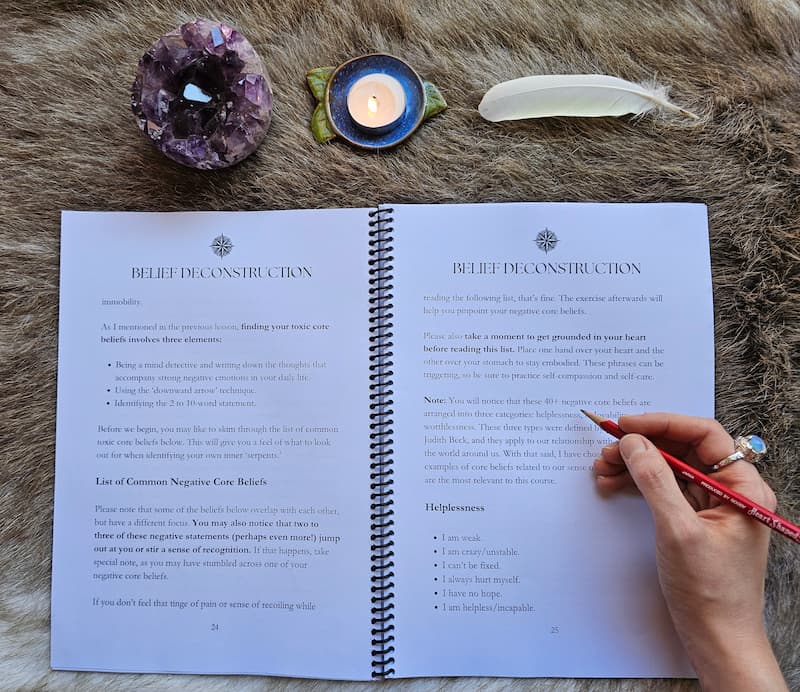
Keep in mind that the above list only displays a sample of the many possible core beliefs that could exist within you. If you want to use the exact “Belief Deconstruction” method I used to find my top three core beliefs, see the Soul Work Compass Course.
5 Ways to Uncover Your Core Beliefs (the Fundamentals)

It is vital that you uncover as many of your core beliefs as possible.
For over a decade, we've strived to make this website a haven of free, valuable information. Imagine a world where this knowledge wasn't readily available. If this post sparked a meaningful insight or helped you in any way, please consider a donation as a heartfelt "thank you" for keeping this resource free. Every contribution, big or small, allows us to keep giving back.
 $3
$3Here is what you need to know:
1. They always start with “I am…”
Go and revisit the list of toxic core beliefs above. Can you see how nearly all of the toxic core beliefs start with “I am …” Others start with “I don’t,” “I always,” etc., which tend to sound quite judgmental. Remember that your toxic core beliefs will be in black and white language that condemns you in some way.
2. They are often disguised by supporting beliefs
Yes, these little imps don’t like being spotted. So look out for supporting beliefs that uphold your central core belief/s. Supporting beliefs often sound like the following:
- “She never cared for me” (I am unlovable)
- “He is such a show-off, I can’t stand it” (I am unimportant)
- “They’re always messing everything up” (I am helpless)
- “I’m sorry that I keep making mistakes, I’m a klutz” (I am a failure)
Pay attention to the things that you often say that make you feel a little insecure, self-conscious, or embarrassed. These uncomfortable emotions will help you pinpoint a supporting belief statement that contains a core belief of yours.
3. Practice journaling and try the ‘why?’ technique
Record the thoughts you have about yourself and other people during the day.
Next to each thought, ask “Why?” and ask the questions, “Why is that so bad?/Why is that so important?” Keep asking these questions until you reach a core answer.
For example, you might write, “I hate how my friend keeps interrupting me.” Why is that so bad? “Because I want to be listened to.” Why? “Because I want to be cared for.” Why? “Because I feel like no one cares about what I have to say.” Why is that so important? “Because I feel alone and worthless.” From this example, we can infer that the core beliefs are “I am worthless” and/or “I am alone.”
We offer a guided approach in the Soul Work Compass Course if you’d like a simpler and more structured approach.
4. Painful emotions are your friends
Uncovering your toxic core beliefs can be invigorating and empowering – but also intimidating and a little scary. Remember that painful emotions are your friends.
When you pay attention to the fluxes and surges of unpleasant emotions from a place of compassion, it helps you uncover your inner blockages. Do you feel anxious, gutted, enraged, self-conscious, insecure, nauseous, or otherwise uncomfortable in your own skin? Good. You know that you’re coming close to unveiling a core belief of yours.



It’s like pulling out a splinter: you’ll feel the pinch of sharp pain first, but that’s a necessary part of the healing process. It all starts with befriending your painful emotions.
5. Practice self-compassion
As you can see, being kind to yourself (self-compassion) is a crucial part of this process. Extracting your toxic core beliefs can backfire if you use the information as an opportunity to bully yourself. Please don’t do that. You didn’t choose to have these toxic core beliefs: they developed as part of your childhood wounding and conditioning.
So be compassionate and go at your own pace – that will make this journey into something nourishing and empowering, not into a witch hunt meant to ‘eradicate’ all of your demons. I help you learn how to befriend yourself through a series of 60+ healing activities and deep-dive prompts in our Self-Love Journal if you need more support.
How to Change Your Toxic Core Beliefs in 9 Steps

As we’ve seen, core beliefs are the fundamental convictions we have about ourselves – the so-called “absolute truths” we have adopted throughout our lives, usually starting in childhood.
For example, if we had an emotionally unstable father as children who constantly punished us and called us “stupid,” it’s likely that we would then develop the core belief that we are “stupid” or “worthless” growing up. Or if we had a neurotic mother who was constantly warning us to “be safe,” we might have developed the belief that “we are not safe,” creating an endless array of psychological problems in our later lives.
Once you have discovered your core beliefs, the next step is to actively replace them. Below, I’ll show you how to change your core beliefs in a relatively straightforward way.
Don’t forget that you can start our Soul Work Compass Course now if you want more structured help in identifying your core beliefs (as well as your core wounds, core needs, and core values – all using the power of spiritual alchemy to empower you).
Keep in mind that any form of inner work demands time, energy, and persistence. But remember, everything you put out is returned to you tenfold!
1. Identify one core belief at a time
It’s pointless to try to rush the process of healing by trying to solve every core belief you’ve identified all at once. Start with the most severe and persistent core belief first. Often, you’ll discover that there is one main core belief that seems to pervade a lot of what you think, feel, and do. Target this one first. The smaller and less persistent core beliefs (i.e., the ones that fluctuate with your mood) can come later.
2. Understand how the core belief impacts your life
To truly motivate yourself to change your core belief, you must genuinely understand its impact on your everyday life and your life at large. Meditate or write down the answer to the following question: “How does this core belief impact my life?” You might respond, for instance, “It stops me from feeling confident. It makes me more anxious in public. It makes me doubt and hate myself. It causes me to lose friendships,” etc. Knowing how your core belief harms you will motivate you to make some serious changes.

3. On a scale of 1 to 10, how much do you believe it?
Often, our core beliefs sound completely ridiculous. To the conscious mind, it’s easy to laugh at them and dismiss them. But on an unconscious level, they still remain within us, wreaking havoc. For this reason, it’s important for you to sit down and really reflect on how much you truly believe in your core belief. Don’t forget to be genuine and tell the truth – this can be hard!
On a scale of 1 (don’t believe at all) to 10 (strongly believe), rate how much conviction you have in your core belief. If your score is above 5, ask yourself, “Why do I believe this is true about myself?” You might like to note down or reflect on past memories or experiences that uphold your belief. If your score is below 5, try to identify any emotions (such as fear) hiding behind your disbelief.
4. Explore hidden forms of resistance
Sometimes people hold a core belief that is very strong. When they are presented with evidence that works against that belief, the new evidence cannot be accepted. It would create a feeling that is extremely uncomfortable, called cognitive dissonance. And because it is so important to protect the core belief, they will rationalize, ignore and even deny anything that doesn’t fit in with the core belief.
– Frantz Omar Fanon
There are many reasons why we consciously or unconsciously refuse to change our old core beliefs. Usually, the reasons involve fear of failure, fear of change, and fear of uncertainty. If we have been habituated to think and behave in a certain way all our lives … what will happen if we don’t anymore? And furthermore, what will happen if we fail? Before you try changing your core beliefs, you need to be able to deeply commit to the journey. By becoming conscious of what is holding you back from changing your core beliefs, you will prevent self-sabotage.
5. Find ways to disprove your core belief
Now that you have rated how much you believe in your core belief, try looking at the “big picture.” By finding ways to disprove your core belief, you will prove to your unconscious mind that you are no longer being positively served by this deeply held conviction.
For example, if your core belief is “I am unwanted,” you might like to deliberately look for ways you have been wanted before, e.g., you might write down “When I was 10, my teachers wanted me to be in charge of the class presentation. When I was 16, someone had a crush on me. When I was 19, my friend got upset with me for not wanting to go with her to the movies. Every year, my relatives want me to come to the Christmas get-together. My partner wants to be with me …” and so forth.
6. Find an alternative core belief
After discounting your core beliefs and proving them to be flawed and unrealistic, it is now time to replace them. Find an alternative core belief that contradicts what you currently believe. For example, if you have the core belief “I am ugly,” you might like to replace it with “I am beautiful.” Or if your core belief is, “I am a loser,” you might replace it with, “I am unique.”
It’s important that you choose a core belief that you genuinely believe in. Beware of going over-the-top with your core belief (e.g., “I am rich and famous”). Instead, try to be realistic and down-to-earth. Affirmations can help in this step.
7. Explore how your life will change with your new belief
How will your new core belief transform your life? Will it help you to be more joyful, confident, creative, or prosperous? Reflect on, or write down your thoughts. Go into as much detail as you like and take pleasure in visualizing the future.
8. If you don’t change your core beliefs, what will be the consequence?
It helps to keep in mind the natural consequences of continuing to cling to a toxic core belief. Not only will this help to motivate and keep you on track, but it will also help to reassert the true value of your journey.
9. Develop a plan of action
After identifying, challenging, and replacing your core belief, you need to have a plan of action in place. Ask yourself what you plan to do in the next month to constantly override your thinking patterns that are associated with your negative core belief.
For example, you might plan to remind yourself of three ways you are lovable every time your core belief “I don’t deserve to be loved” pops up. Some other ideas include:
- Keeping a journal where you record your progress
- Setting aside time every day in solitude to introspect
- Looking at yourself in the mirror every morning, repeating your new healthy core belief sincerely
- Visualizing/hypnotizing yourself into a suggestible state that prepares your unconscious mind for change
The possibilities are limitless. And remember that it’s normal to slip up or forget – just be gentle with yourself and keep persisting!
If you’re looking for a place to start, I recommend exploring mirror work and coupling this with an empowering affirmation (see step 6 above again).
A Simple, Structured, and Powerful Way of Finding Your Core Beliefs
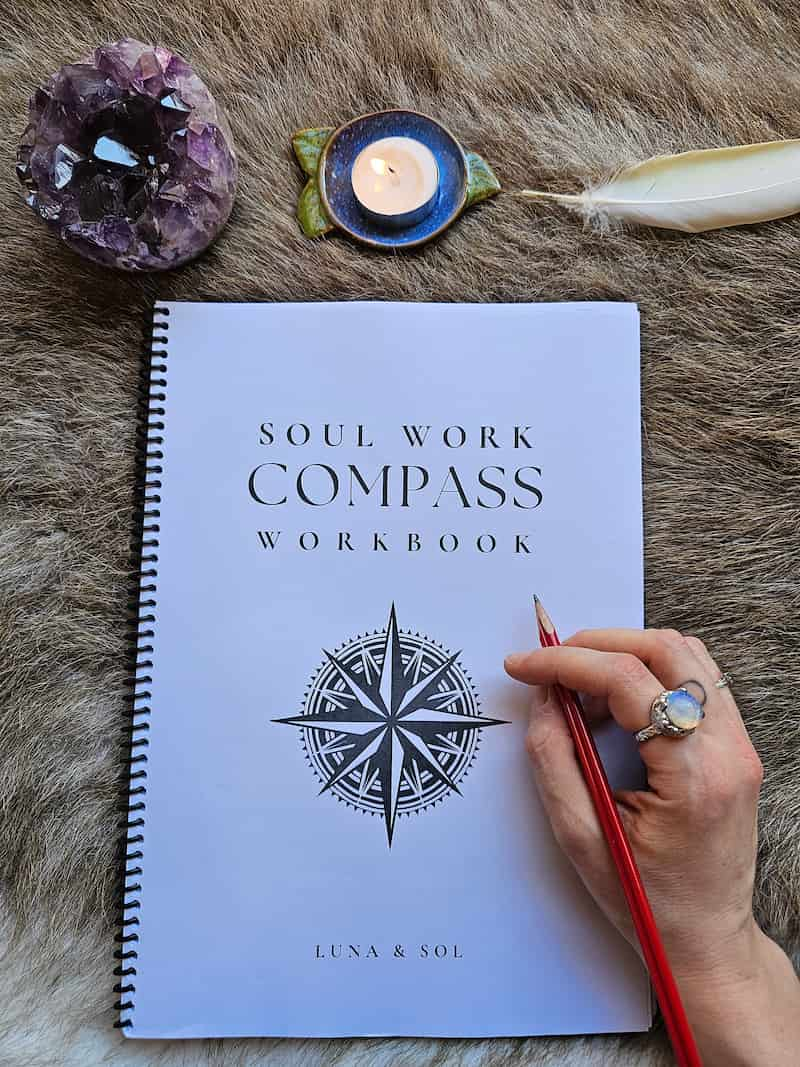
Reading about toxic core beliefs is one thing. Actually finding yours – and doing something about them – is another. That’s exactly what the Soul Work Compass Course was created for.
Using the timeless framework of alchemy, this 12-lesson journey guides you step by step through identifying your core wounds, deconstructing the limiting beliefs keeping you stuck, clarifying your non-negotiable values, and – most powerfully – authoring new beliefs that actually reflect who you are at a soul level.

Shadow Work Journal:
⭐️⭐️⭐️⭐️⭐
"Wow! Wow! Wow! I’ve bought three books of yours so far and they’re high-quality works - and helped me so much. But the Shadow Work Journal is truly something! Right from the first exercise, a core wound of mine (deeply buried inside my shadow) was effortlessly revealed to me! Your instructions helped me go layer by layer to uncover that wound underneath my unhealthy pattern." – Maha
Uncover Your Core Wounds!
You’ll walk away with your own personal Soul Compass: a tangible, fillable document that becomes your north star for making aligned decisions and living with genuine authenticity.
This isn’t surface-level self-help. It’s the deep, structured inner work that transforms repetitive cycles of pain into a life of real meaning and direction. If you’re ready to stop surviving and start living from your truth, the Soul Work Compass Course is where that journey begins.
***
As you walk the challenging, but deeply fulfilling path of uncovering your core beliefs, remember that some core beliefs are more persistent than others.
It’s common for some core beliefs to fluctuate with your emotions (pay attention to these), but also look out for those that emerge even when you aren’t feeling emotional (these are often the deeper, more serious core beliefs).
Replacing your core beliefs will take time and effort, but the rewards are endless and priceless. Increased self-esteem, creativity, productivity, prosperity, joy, fulfillment, and love are some of the many gifts you will receive throughout this journey.
Tell me, have you discovered any of your core beliefs? What are they? Feel free to share below. And also, if you benefited from this article, please share it with a loved one!
If you need more help, we offer 2 powerful ways to guide you on your inner journey:
1. The Soul Work Compass Course: Break free from feeling lost and disconnected. The Soul Work Compass is a practical 12-step course that transforms soul loss into soul clarity. Discover your core values, heal core wounds, and create a personalized compass to guide every decision you make.
2. The Inner Work Journal Bundle: Heal at the root. This Inner Work Journal Bundle guides you through self-love, inner child healing, and shadow integration with 150+ prompts and activities. You get editable digital files to use on any device or print unlimited times. Not for lukewarm seekers, these journals are for those ready to transform.
I really need to do this, I have always had trouble sticking to and finishing. I completely get what I need to do, I just need help doing it. My core feelings are worthlessness, bad, dirty, not good enough. I am seriously broke right now. I literally live off of $400 a month I can’t afford to go to retreats or spiritual therapy, and regular councilors and psych people don’t get into this. They are more interested in the bottom dollar and pills. I am reaching out, begging for help. I can not live like this anymore and I would never commit suicide and cause my children that kind of pain. I would continue to live in this he’ll if I can’t get help. Please respond. Not with a generic letter, but one from you . please. I’m 48 and have no friends, the love of my life couldn’t take it anymore after 20 years. My kids are 19 and24, way too young to have to be responsible for me like this. My name is Kristine.
I go back to this article over and over to re-read it because it contains such good information.
To change the lies of our core beliefs we have to know what the truth is. Therefore we surely need to check what we are replacing the lies with? There was a man who said he was the way the truth and the life. Could he be the answer to finding truth?
Thank you for bringing this subject up. I have been working on my core beliefs and I can honestly say that for me it all comes down to believing myself to be some kind of an intruder in this world. I cant remember a time when I didnt feel completely out of step with everything and everybody. I chose to respond to that feeling by spending my entire life jumping in and out of characters in an effort to please everyone else. I guess I assumed that if I was everybody’s favorite everything that they wouldn’t mind my intrusion on their planet. I figured out early in life that I could easily read people and situations so it just became a matter of course to turn myself into whoever you wanted me to be. I am 57 yrs old and just now coming to the realization that there is no “Me” in this equation. I am now and have always been EXACTLY who the Universe needs me to be in every situation. No more, no less. I simply don’t exist in any real way when I am not actively serving others! Talk about heaping a ton of crude onto yourself!! Not surprisingly 57 years of being a means to an end for everyone has left me bitter, broken, and completely empty.
My core belief has forever been “I do everything wrong/I can’t do anything right.” It has resulted in attempts to maintain a false idea of perfection. I was a different child but insecure in my differences, and I responded immediately to “You need to do this the right way.” I didn’t want to upset the apple cart, and wanted my parents to be proud of how well I listened and followed directions. When I look back to how all of those “you are doing it wrong” comments, they are heartbreaking. I feel the sinking feelings all over again of not fitting in with this world. The more I tried to fit in as I got older (teen and early adult years) the worse things got.
Now that I am well into adulthood (I am 41) I have had ample time alone to start working on this stuff. I am married and have 3 boys, but they are all in full time school now and I do not work. I started doing all the work from the outside, as you mention in this article. Again trying to obtain perfection in my diet, my home environment, my parenting, my yoga and meditation practices, even my journaling. Sometimes I struggle even to write because I feel I will say it wrong (even though no one will see it!). But the desire to do the work from the inside has gotten quite strong over the past several months. Thankful for you page to help direct me on the journey!
I no longer worry so much about fitting in or not rocking the boat, but it causes me anxiety when people (mostly my parents still) ask why I can’t just do things the way they do them. Why I don’t care about finances or retirement or home design. I simply don’t worry about those things. But still, knowing my parents still question why I can’t just do things the right way is quite bothersome to me. It greatly impacts my perception of and relationship with my mom as a result. She is a person who does try to understand but she cannot see things from another perspective, so any discussion ends up with her getting fearful and upset because she thinks I am not taking care of my life. So that is the part of it I am working through now that I have been able to identify that major core belief. It has resulted in other beliefs of me feeling stupid because I can’t just get on the bus and do things like everyone else does them. I see and understand the world completely differently than most people, and sometimes it’s lonely. I’m ok with that. But the people closest to me apparently are not, lol. They are so fearful, it emanates off them like old lady perfume. And it makes me upset that they are afraid for me. I don’t want that.
Sorry to ramble. I copy/pasted to my journal so i can continue to write from there. Thank you for all of the resources.
We are all made differently Kimbr and in a way that is the beauty of humanity. We don’t have to be carbon copies of each other. Although we should identify lies and replace it with truth, we are still made specially and are one offs. No two snowflakes are exactly alike. We cannot change people by making them like us and in a sense that is the beauty of relationship and even marriage.
I’d like to start my journey. I deeply believe that waste, redundancy, and forcing help on others is immoral, but I don’t know how to find the core beliefs driving those. Perhaps I’m operating on a paradigm of lack. It seems that people are constantly forcing unsolicited help on me and treating me like I’m stupid. I just want it to stop. I want people to see me at my true level of competence and take it for granted that I am a normal, functioning adult. I want the freedom to get to check doors of closed businesses without anyone treating me like I’m too stupid to find out myself by telling me. It’s important that I get to live my life as an alone journey and get to experience it full strength. Every time I get the chance to prove myself, someone ALWAYS seems to steal it from me.
Related to the above is intrusive memories where the events of unwanted help play in my mind over and over. I feel angry and powerless as the memories take over me.
So can anyone point me in the right direction as to what my core beliefs are in all this?
One of your core beliefs is knowing that we each have our own race. Although one can shout encouragement it is essentially our own race. That is a correct core belief I believe. This shows in the help you do not want as it isn’t really helping you to run your race. It’s not to say we do not need help sometimes and we should welcome that, but if we don’t need it it can be a bit wasteful.
I’m a first year in a counselling foundation degree and on completing my personal development can’t seem to grasp what my core beliefs are. Its very frustating!
I had a whopper of a Freudian slip this morning. I started reading your e-book called 101 Questions To Ask About Your Life. There was a line: “May your journey of self-inquiry be joyful and revealing.” My mind read “journey of self-INJURY.” Holy shit. I think that shows just what a formidable mountain I’m trying to climb. And I will always be climbing it, just like Sisyphus. What a perfect metaphor for life. This is really scary. Never underestimate the power of your subconscious mind to screw you without your conscious knowledge or permission. It’s a horrible feeling knowing that you are still the puppet your parents made you into, and they will always be pulling the strings. It’s like Loki, the god of mischief – he’s the subconscious mind that is always ready to pull the rug out from under you. Thor is the conscious mind. It makes sense that the 2 are almost always at odds. There’s a part of me that is fiercely dedicated to hurting myself. And it will always be there.
Hello Aletheia,
First, I want to thank the team behind
Lonerwolf for providing such intricate and useful information for
self-exploration. I have found this article to be extremely insightful for me,
yet more I indulge in it, more questions arise. I wonder, how many core beliefs
can a person have? I doubt there can be too many, because from my understanding,
the things that dwell in our subconscious pshyche tend to be basic, simple, and
connected to the most primitive of our responses. I have found four core
beliefs so far in my case, and i wonder should I go ‘further’ (search for more
of them) or ‘deeper’ (try to formulate them even more simple). I hope you
understand my question :)
I join you after a full lifetime where I have experienced much but have never before thought about looking inward. This is completely new for me and I am a new soul at it. I am going to try not to forget about the way that I am feeling – by recording my feelings and inner beliefs. Thank you for being here