
This article is part of the Authentic Self hub, a single thread within the broader practice of inner work.
Read more from this hub →
When you first dig up the festering mess of your core beliefs from the depths of your being, you’ll likely experience one of three emotions: excitement, confusion, or grief – or all three at once.
As one of the most fundamental practices on the journey of inner work, uncovering our toxic core beliefs is definitely not a clean or sanitary path.
But it is vital.

Soul Work Compass Course:
Feeling lost, stuck, and trapped in repetitive cycles of pain? Discover your Soul's Compass to reclaim your purpose and find your path to freedom.
⭐️⭐️⭐️⭐️⭐️ "I have been a long-time subscriber to their website, and it’s one of my favorites by far ... It is rare to find this type of teacher." – Shar B.
We ALL carry our own devilish assortment of toxic core beliefs that eat away at our sanity on either a conscious or unconscious level. Typically, they influence every level of our being.
To effectively develop self-love, open our hearts to others, experience more inner peace, and live from our authentic self, we need to turn inwards. We need to illuminate the darkness. Going in search of your core beliefs is one of the most essential paths for true and deep healing because it goes to the center of your suffering.
Table of contents
What Are Core Beliefs?

Our core beliefs are the unconscious stories, convictions, and judgments we carry about ourselves that define our sense of self. Core beliefs also determine how we feel about others, how happy we are with ourselves, and how we perceive the world at large.
Our core beliefs are even responsible for how successful we are in self-actualizing our deepest dreams and uncovering our personal meaning of life. In short, our core beliefs influence every aspect of our lives. Typically, our core beliefs first develop in childhood and solidify in adulthood.
Core Beliefs and Spiritual Awakening
We heal ourselves on the mental level as we become aware of our core beliefs, release those that limit us, and open to more supportive ideas and greater understanding.
– Shakti Gawain
The whole point of the healing journey of awakening is to loosen our attachment to that which is false and limiting – and this includes our core beliefs. These core beliefs can become so dense and constricting that they contribute to a Dark Night of the Soul (or spiritual crisis).
In Indian philosophy, core beliefs are related to the idea of samskaras, or patterns of conditioning that we continuously repeat in our lives. To connect with our True Nature, we need to become aware of these inner contractions that tend to undermine, control, and pollute our way of living and being.
Why You Keep Repeating the Same Toxic Patterns

Just when you think you have a pretty good idea of who you are … just when life seems to be going well … everything starts spiraling downwards …
Want to get LonerWolf at the top of your Google search results?
Have you ever felt this way before?
(Note: most of us have at some point in our lives!)
We’ve all experienced periods of life where everything is sunshine and roses. We seem to be on the right track. And then – out of nowhere – a mysterious depression descends upon us. (Surprise! ) Or we get a huge anxiety attack that cripples our self-esteem. (Surprise!) Or we self-sabotage, attract the wrong person into our lives, and wind up heartbroken. (Surprise!)
Why does this happen?
You can probably guess what I’m going to say. Yes, our core beliefs are what happened.
“But I’ve focused so much on self-growth and spirituality – what’s going wrong?” you might lament.
My answer is that, most likely, you haven’t gone deep enough into your psyche to undo your old patterns. You’ve most likely taken the outside-in approach where you:
- change your diet
- take care of your body
- ‘hack’ (optimize) your daily routines
- read lots of self-help books
- do sexy yoga
- organize your life
… but for the most part, these are all very external or superficial practices. No matter how much you work on your external life, you still find yourself consumed by toxic shame, anger, self-pity, and self-destructive behaviors.
Don’t worry, it’s not your fault. No one taught you that you need to take the hard path, peek underneath the curtain of your mind, and shine a torch into its deepest recesses.
That’s where this article (and our whole website) comes into play.
Would you like to save this?
Your information will never be shared.
Examples of Core Beliefs to Look Out For

A core belief is not an everyday garden variety belief that pops up spontaneously – it is the mother of all beliefs, the Big Kahuna of suffering, and the King or Queen of your own personal underworld that becomes the central part of your shadow self. This is why shadow work is one of our most recommended methods for exploring our core beliefs.
Often, we are completely unaware of what our core belief/s are (even if we think we are “conscious”!) – and it is quite common to disbelieve their existence.
As I mentioned at the beginning, discovering your core beliefs will cause you to feel a cocktail of surprising emotions (from grief to disbelief). But whatever the case, the truth is that we all have core beliefs and we’re all manipulated by them.
“But I’m a spiritual person: I’ve dedicated so many years to self-improvement!”
Maybe so. But if you’re still continuing to suffer, chances are that you haven’t done the dirty work of digging through the quagmire of your mind first.
In fact, I once used the same justification to avoid the fact that I struggled with some very real, very problematic core beliefs. Eventually, I learned the hard way. Thanks to the constant re-emergence of toxic guilt and shame I developed due to childhood conditioning, I discovered three main core beliefs about myself: (1) I am bad, (2) I’m not good enough, and (3) I’m an imposter.
I was a little speechless when I discovered these core beliefs! They seemed so familiar, so big and scary – and yet there they were, condensed into simple little sentences that I could imagine a sad and scared little child repeating. (And indeed, they do come from the wounded inner child.)
Here are some other examples of common toxic core beliefs that we carry inside. Pay attention to those that generate feelings of discomfort within you:
- I am irredeemably flawed.
- I am unlovable.
- I am bad.
- I am stupid.
- I am worthless.
- I am a loser.
- I don’t deserve good things.
- I am a failure.
- I am weak.
- I am not enough.
- I don’t matter.
- I am boring.
- I am crazy and unstable.
- I can’t be fixed.
- I always hurt people.
- I always hurt myself.
- I have no hope.
- I am evil/sinful.
- I am unwanted.
- I am invisible.
- I am a mistake.
- I am helpless.
- I am ugly.
- I am shameful.
- I am uninteresting.
- I will die alone.
So, which of the above core beliefs stood out to you?
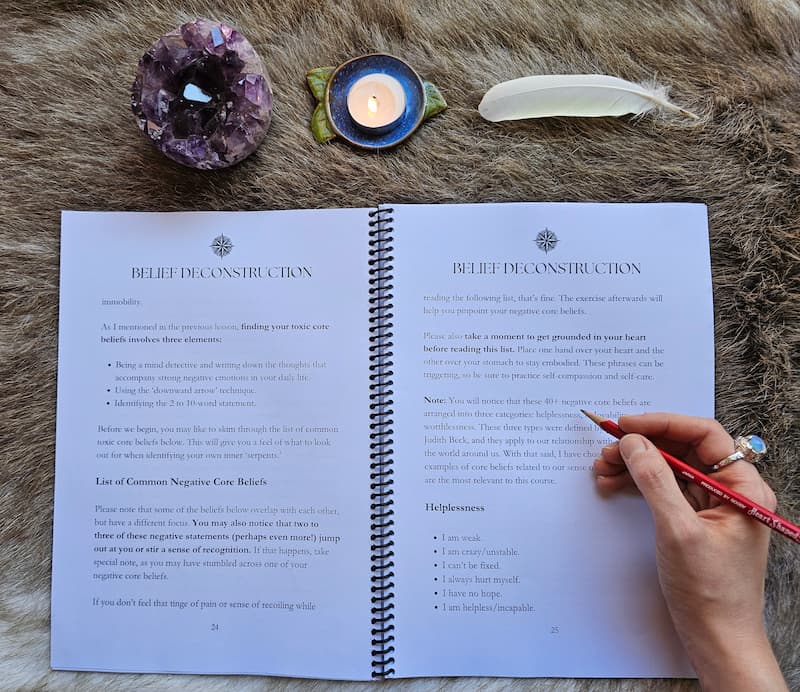
Keep in mind that the above list only displays a sample of the many possible core beliefs that could exist within you. If you want to use the exact “Belief Deconstruction” method I used to find my top three core beliefs, see the Soul Work Compass Course.
5 Ways to Uncover Your Core Beliefs (the Fundamentals)

It is vital that you uncover as many of your core beliefs as possible.
For over 15 years, we've strived to make this website a haven of free, valuable information. Imagine a world where this knowledge wasn't readily available.
If this post sparked a meaningful insight or helped you in any way, please consider a donation as a heartfelt "thank you" for keeping this resource free.
Every contribution, big or small, allows us to keep giving back.
 Yes, I'd Like to Help
Here is what you need to know:
1. They always start with “I am…”
Go and revisit the list of toxic core beliefs above. Can you see how nearly all of the toxic core beliefs start with “I am …” Others start with “I don’t,” “I always,” etc., which tend to sound quite judgmental. Remember that your toxic core beliefs will be in black and white language that condemns you in some way.
2. They are often disguised by supporting beliefs
Yes, these little imps don’t like being spotted. So look out for supporting beliefs that uphold your central core belief/s. Supporting beliefs often sound like the following:
- “She never cared for me” (I am unlovable)
- “He is such a show-off, I can’t stand it” (I am unimportant)
- “They’re always messing everything up” (I am helpless)
- “I’m sorry that I keep making mistakes, I’m a klutz” (I am a failure)
Pay attention to the things that you often say that make you feel a little insecure, self-conscious, or embarrassed. These uncomfortable emotions will help you pinpoint a supporting belief statement that contains a core belief of yours.
3. Practice journaling and try the ‘why?’ technique
Record the thoughts you have about yourself and other people during the day.
Next to each thought, ask “Why?” and ask the questions, “Why is that so bad?/Why is that so important?” Keep asking these questions until you reach a core answer.
For example, you might write, “I hate how my friend keeps interrupting me.” Why is that so bad? “Because I want to be listened to.” Why? “Because I want to be cared for.” Why? “Because I feel like no one cares about what I have to say.” Why is that so important? “Because I feel alone and worthless.” From this example, we can infer that the core beliefs are “I am worthless” and/or “I am alone.”
We offer a guided approach in the Soul Work Compass Course if you’d like a simpler and more structured approach.
4. Painful emotions are your friends
Uncovering your toxic core beliefs can be invigorating and empowering – but also intimidating and a little scary. Remember that painful emotions are your friends.
When you pay attention to the fluxes and surges of unpleasant emotions from a place of compassion, it helps you uncover your inner blockages. Do you feel anxious, gutted, enraged, self-conscious, insecure, nauseous, or otherwise uncomfortable in your own skin? Good. You know that you’re coming close to unveiling a core belief of yours.



It’s like pulling out a splinter: you’ll feel the pinch of sharp pain first, but that’s a necessary part of the healing process. It all starts with befriending your painful emotions.
5. Practice self-compassion
As you can see, being kind to yourself (self-compassion) is a crucial part of this process. Extracting your toxic core beliefs can backfire if you use the information as an opportunity to bully yourself. Please don’t do that. You didn’t choose to have these toxic core beliefs: they developed as part of your childhood wounding and conditioning.
So be compassionate and go at your own pace – that will make this journey into something nourishing and empowering, not into a witch hunt meant to ‘eradicate’ all of your demons. I help you learn how to befriend yourself through a series of 60+ healing activities and deep-dive prompts in our Self-Love Journal if you need more support.
How to Change Your Toxic Core Beliefs in 9 Steps

As we’ve seen, core beliefs are the fundamental convictions we have about ourselves – the so-called “absolute truths” we have adopted throughout our lives, usually starting in childhood.
For example, if we had an emotionally unstable father as children who constantly punished us and called us “stupid,” it’s likely that we would then develop the core belief that we are “stupid” or “worthless” growing up. Or if we had a neurotic mother who was constantly warning us to “be safe,” we might have developed the belief that “we are not safe,” creating an endless array of psychological problems in our later lives.
Once you have discovered your core beliefs, the next step is to actively replace them. Below, I’ll show you how to change your core beliefs in a relatively straightforward way.
Don’t forget that you can start our Soul Work Compass Course now if you want more structured help in identifying your core beliefs (as well as your core wounds, core needs, and core values – all using the power of spiritual alchemy to empower you).
Keep in mind that any form of inner work demands time, energy, and persistence. But remember, everything you put out is returned to you tenfold!
1. Identify one core belief at a time
It’s pointless to try to rush the process of healing by trying to solve every core belief you’ve identified all at once. Start with the most severe and persistent core belief first. Often, you’ll discover that there is one main core belief that seems to pervade a lot of what you think, feel, and do. Target this one first. The smaller and less persistent core beliefs (i.e., the ones that fluctuate with your mood) can come later.
2. Understand how the core belief impacts your life
To truly motivate yourself to change your core belief, you must genuinely understand its impact on your everyday life and your life at large. Meditate or write down the answer to the following question: “How does this core belief impact my life?” You might respond, for instance, “It stops me from feeling confident. It makes me more anxious in public. It makes me doubt and hate myself. It causes me to lose friendships,” etc. Knowing how your core belief harms you will motivate you to make some serious changes.

3. On a scale of 1 to 10, how much do you believe it?
Often, our core beliefs sound completely ridiculous. To the conscious mind, it’s easy to laugh at them and dismiss them. But on an unconscious level, they still remain within us, wreaking havoc. For this reason, it’s important for you to sit down and really reflect on how much you truly believe in your core belief. Don’t forget to be genuine and tell the truth – this can be hard!
On a scale of 1 (don’t believe at all) to 10 (strongly believe), rate how much conviction you have in your core belief. If your score is above 5, ask yourself, “Why do I believe this is true about myself?” You might like to note down or reflect on past memories or experiences that uphold your belief. If your score is below 5, try to identify any emotions (such as fear) hiding behind your disbelief.
4. Explore hidden forms of resistance
Sometimes people hold a core belief that is very strong. When they are presented with evidence that works against that belief, the new evidence cannot be accepted. It would create a feeling that is extremely uncomfortable, called cognitive dissonance. And because it is so important to protect the core belief, they will rationalize, ignore and even deny anything that doesn’t fit in with the core belief.
– Frantz Omar Fanon
There are many reasons why we consciously or unconsciously refuse to change our old core beliefs. Usually, the reasons involve fear of failure, fear of change, and fear of uncertainty. If we have been habituated to think and behave in a certain way all our lives … what will happen if we don’t anymore? And furthermore, what will happen if we fail? Before you try changing your core beliefs, you need to be able to deeply commit to the journey. By becoming conscious of what is holding you back from changing your core beliefs, you will prevent self-sabotage.
5. Find ways to disprove your core belief
Now that you have rated how much you believe in your core belief, try looking at the “big picture.” By finding ways to disprove your core belief, you will prove to your unconscious mind that you are no longer being positively served by this deeply held conviction.
For example, if your core belief is “I am unwanted,” you might like to deliberately look for ways you have been wanted before, e.g., you might write down “When I was 10, my teachers wanted me to be in charge of the class presentation. When I was 16, someone had a crush on me. When I was 19, my friend got upset with me for not wanting to go with her to the movies. Every year, my relatives want me to come to the Christmas get-together. My partner wants to be with me …” and so forth.
6. Find an alternative core belief
After discounting your core beliefs and proving them to be flawed and unrealistic, it is now time to replace them. Find an alternative core belief that contradicts what you currently believe. For example, if you have the core belief “I am ugly,” you might like to replace it with “I am beautiful.” Or if your core belief is, “I am a loser,” you might replace it with, “I am unique.”
It’s important that you choose a core belief that you genuinely believe in. Beware of going over-the-top with your core belief (e.g., “I am rich and famous”). Instead, try to be realistic and down-to-earth. Affirmations can help in this step.
7. Explore how your life will change with your new belief
How will your new core belief transform your life? Will it help you to be more joyful, confident, creative, or prosperous? Reflect on, or write down your thoughts. Go into as much detail as you like and take pleasure in visualizing the future.
8. If you don’t change your core beliefs, what will be the consequence?
It helps to keep in mind the natural consequences of continuing to cling to a toxic core belief. Not only will this help to motivate and keep you on track, but it will also help to reassert the true value of your journey.
9. Develop a plan of action
After identifying, challenging, and replacing your core belief, you need to have a plan of action in place. Ask yourself what you plan to do in the next month to constantly override your thinking patterns that are associated with your negative core belief.
For example, you might plan to remind yourself of three ways you are lovable every time your core belief “I don’t deserve to be loved” pops up. Some other ideas include:
- Keeping a journal where you record your progress
- Setting aside time every day in solitude to introspect
- Looking at yourself in the mirror every morning, repeating your new healthy core belief sincerely
- Visualizing/hypnotizing yourself into a suggestible state that prepares your unconscious mind for change
The possibilities are limitless. And remember that it’s normal to slip up or forget – just be gentle with yourself and keep persisting!
If you’re looking for a place to start, I recommend exploring mirror work and coupling this with an empowering affirmation (see step 6 above again).
A Simple, Structured, and Powerful Way of Finding Your Core Beliefs
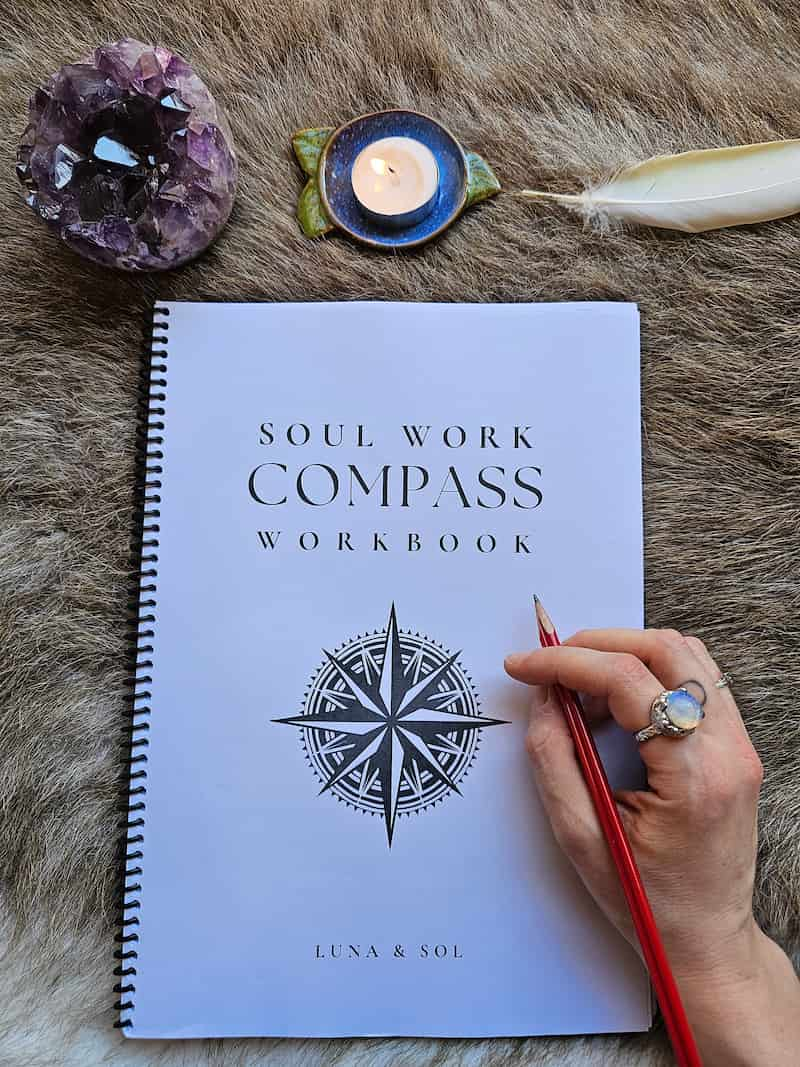
Reading about toxic core beliefs is one thing. Actually finding yours – and doing something about them – is another. That’s exactly what the Soul Work Compass Course was created for.
Using the timeless framework of alchemy, this 12-lesson journey guides you step by step through identifying your core wounds, deconstructing the limiting beliefs keeping you stuck, clarifying your non-negotiable values, and – most powerfully – authoring new beliefs that actually reflect who you are at a soul level.

Shadow Work Journal:
⭐️⭐️⭐️⭐️⭐
"Wow! Wow! Wow! I’ve bought three books of yours so far and they’re high-quality works - and helped me so much. But the Shadow Work Journal is truly something! Right from the first exercise, a core wound of mine (deeply buried inside my shadow) was effortlessly revealed to me! Your instructions helped me go layer by layer to uncover that wound underneath my unhealthy pattern." – Maha
Uncover Your Core Wounds!
You’ll walk away with your own personal Soul Compass: a tangible, fillable document that becomes your north star for making aligned decisions and living with genuine authenticity.
This isn’t surface-level self-help. It’s the deep, structured inner work that transforms repetitive cycles of pain into a life of real meaning and direction. If you’re ready to stop surviving and start living from your truth, the Soul Work Compass Course is where that journey begins.
***
As you walk the challenging, but deeply fulfilling path of uncovering your core beliefs, remember that some core beliefs are more persistent than others.
It’s common for some core beliefs to fluctuate with your emotions (pay attention to these), but also look out for those that emerge even when you aren’t feeling emotional (these are often the deeper, more serious core beliefs).
Replacing your core beliefs will take time and effort, but the rewards are endless and priceless. Increased self-esteem, creativity, productivity, prosperity, joy, fulfillment, and love are some of the many gifts you will receive throughout this journey.
Tell me, have you discovered any of your core beliefs? What are they? Feel free to share below. And also, if you benefited from this article, please share it with a loved one!
Two paths to inner transformation – here’s how I can help you go deeper:
1. The Soul Work Compass Course: Feeling lost or stuck in repetitive cycles of pain? The Soul Work Compass Course is your guide to reclaiming your true purpose. In this deep yet practical journey, you’ll learn how to heal core wounds and create a tangible "Soul's Compass" to navigate life with clarity. Enroll now and find your True North!
2. The Inner Work Journal Bundle: Ready for deep transformation? This bundle includes three powerful journals – Self-Love, Inner Child, and Shadow Work – with 150+ prompts to heal wounds, integrate your darkness, and experience bone-deep change. Digital & printable. Print unlimited times.
This is brilliant, it details very similar methodology to what I do in CBT. I’ve learnt the hard way that true growth only occurs once you confront what’s lying inside, so fabulous article!
♡
after going through the core beliefs when I reached , I am a mistake, it hit me like a ton of bricks my heart started to beat hard , tears started flowing, I knew I hit a big core belief, I closed my eyes and embraced my feelings even though very painful I begin saying softly to myself as tears continue to flow “ I am NOT a mistake and I never was a mistake, I radically forgive and release everyone who thought otherwise.” Thank you so much for your contribution towards healing many damaged souls in this world. My heart goes out to you. Thank you.
This warms my heart and really hits me – I’m so glad this guidance impacted you in such a big way! Good on you for being kind and compassionate toward yourself – holding that pain without trying to push it away, judge, or avoid it is crucial in the healing process. “You must feel it to heal it.” Much love to you, Karen!
For two months, I’ve suddenly find myself in a shadow work. I experienced unexpected loses which made me to think I am stupid hopeless and worthless. And your articles have reached me during this period as a special and valuable guide. Thank you so much. And thank you for providing people a sound ground and step-by-step understanding for self growth and transformation among all those more-and-more noises.
I have identified and come to terms with 4 wounds during my inner child work, in which i truly believe they have fully resolved. Now i have a strong sensation to dig into shadow work. I’m not so much as afraid of what i will find probably just hesitant on starting due to not sure where to start. Thank you for this article it opened my eyes and mind on core beliefs even further then I’ve read on your website and articles. I honestly believe that my shadow work journey will be challenging, daunting yet i truly believe at this point its exactly what i must do. I am ok with the fact i may slip up during this journey, without acknowledging your mistakes and failures you cannot have any successes.
Thank you Yasemin ♡
I was out walking in the woods a few weeks ago when I felt my body starting to relax at a deep, inner level. For the first time in my life, I started to feel: “I have a RIGHT to be here–to be living here on Earth and walking in this park right now. Mother Earth supports me, the same way she supports every living and non-living thing on her. I am not a burden or an imposition on her.”
And I think that that is what you are calling a “core belief”: That I was a burden and an imposition on everyone in my life. That no one really wanted me. That I had to prove myself worthy of being alive by doing everything I could for everyone else.
And I knew exactly where that belief came from. I was given up for adoption by my birth mother. Unbeknownst to me (I only learned this recently), she spent months living on the opposite side of the country before she agreed to sign the papers relinquishing me. (My suspicion is that she was trying to use my existence to lure her lover away from his wife and children. If so, the attempt failed.) I didn’t end up in a “forever” home until I was 8 months old. (That’s a long time in a developing child’s life, as I know from my own experiences as a mother). By that point, I was “used goods,” so to speak, so I didn’t exactly end up with the adoption agency’s first choice of families. In fact, the “mother” who adopted me was a malignant narcissist who wanted a child for only 2 reasons: 1) for social acceptability, and 2) so that she could have someone in her life to wield power over. (Fortunately, my adopted dad was a kind, decent man. He’s the only reason I’m sane today.) Anyway, my “mother” never let me forget either how much worse SHE always had things as a child or how grateful I should be to her. She spent her life ordering me around and—I didn’t realize this until about 5 years ago—deliberately being cruel to me in any way that she could get away with. I was so desperate to be LOVED that I spent my entire life obeying her. And more than just obeying her; trying to anticipate everything she could possibly want so that she wouldn’t punish me for not making her happy.
And then, as I say, about 5 years ago (after having had a literal heart attack) I woke up.
I thought I had done a lot of inner work since then, but yes, you’re right, there are layers beneath layers.
That day in the park, I reached the deepest one yet: the belief that I was unwanted (thanks, birth mother) and the belief that I was a burden and an imposition on everyone in my life (thanks, adoptive “mother”).
Those beliefs are LIES. And I realized that none of them had anything to do with ME. My birth mother would have treated ANY child the same way. And my adoptive “mother” would have treated ANY child the same way. IT WASN’T ABOUT ME; IT WAS ABOUT THEM.
I realized that I am NOT a burden or an imposition on anyone. I am, in fact, kind, loving and supportive of the people in my life. And I have just as much right to be here on Mother Earth as ALL her children do.
Your story moved me quite deeply.
Mine is nothing like yours in how it played out, but my core beliefs are similar.
I had a deep realization of what has happened to me and how to deal with it/heal it after I read a book called The Boy Who was Raised as a Dog, by Bruce D. Perry and Maia Szalavitz. It’s a “compilation” of stories about severely traumatized children, and exactly what happens to the development of our brain (underdeveloped areas and overstimulatedd areas) and also both simple and complex ways of treating/healing these wounds.
I cried, both in deep sorrow and in optimisim, while reading this book.
And your conclusion is 100% right. The way we feel about ourselves, as a consequence of how we were treated as children, isn’t so much about us as it is about our caretakers.
Both my parents are malignent narcissists or psychopaths, so everything has always been centered around their pain or views of the world. My pain and my views were never validated. And to boot: I am the youngest among four siblings, and has always been treated as an emotional dumping grounds.
I do however see that the neglect and abuse I’ve been subjected to is a reflection of very deep and sad wounds that they themselves carry, and that – unlike you and me (and others) – they have never learned how to del with it, how to work through it, and so the only release they can get from the pain within themselves is to dump it on somebody else. And people that dump their shit upon others tend to do so on the most vulnerable among us. Because it’s easier for them to manipulate those around them into believing that they have done nothing wrong and that the fault lies entirely at their victims.
Thank you for sharing your story.
I am happy that you have come so far on your journey. It is, in a sense, groundbreaking to realize in truth that you are valuable, wanted, and cared for.
I guess the truth will set us free, but I think love is a key part in what “truth” is. At least for those that has a love for truth.
Take care, brave soul!
We are all so much more than our wounds.
Yes, absolutely JC. Love is the core part of truth – love is what brings us home to our innate worthiness and loveability. We are indeed so much more than our wounds!
♡
“IT WASN’T ABOUT ME; IT WAS ABOUT THEM” – YES, 1000%! This is such a deep and transformative breakthrough! And I’m so glad you experienced how truly loving and supportive you are (and how you do, and always have, belonged here). Much love! Thank you for sharing Nancy!
Great article on core of belief…..I had realized that in order for me to get rid of any negativity going on in my life is have to gain control of my thought process and just start thinking positive
I really love this article. It’s so insightful and I feel like beliefs are such a powerful thing. One of the hardest lessons I ever learnt was that what one may believe may not exactly be the truth. It’s really devastating in the case of a positive belief, but when it comes to negative core beliefs? It can be so empowering. A big core belief I used to have is that I’m not talented or good at anything. I’ve come a long way since then but wrestling with one’s inner critic can be quite the challenge still. So glad you provided tangible tips for inner work. Thank you.
Thanks for your vulnerability, Srujanika!
When I was in my 20s, a few of us would sit in a late night diner. Every one ordered except for me. I always had a cup of tea. No one questioned it. This went on for over 2 years. I don’t Romberg why I changed. I did find a picture of me wearing a small halter top. I thought I looked great then. My ribs were protruding and I was obviously malnourished. I still feel sad for that girl.
I have most of the core issues that you put out. I catch myself now when I do something wrong….I don’t tell myself I’m stupid…instead I laugh and talk as if it were my 6 year old granddaughter. I laugh and say “oh you silly girl”. I would never tell my granddaughter she was an idiot or she should know better and now I pretend I’m a six year smart fun girl.
I like the way you approach yourself, Valorie – it’s much more compassionate than insulting or bullying yourself. Good on you! Light-heartedness is always a great antidote the the dire seriousness carried by toxic core beliefs.
where do inhibitions play in all of this, only asking because someone once told me that one of my inhibitions is restricting my spiritual growth
Inhibitions are usually directly connected to core beliefs – they’re a symptom of them. For instance, part of us may be limited because we carry a core belief that “I’m not good enough” or “I’m a failure,” etc. That being said, sometimes inhibitions are helpful. It wouldn’t be great to blurt out in the middle of a business meeting that you need to go do a big fat turd, would it! haha It’s all about context and how helpful/healthy a form of behavior is.
Thank you so much! This is clear and thorough. It’s precisely the wisdom I’ve been seeking for quite some time to learn how to get to and release these monsters of mine. Every word resonates with me. This year I have been led to begin setting intentions in the New Moon. This cycle, my word is “Release.” Pretty sure I’ll need more than one lunar revolution to really live into that word, but this cycle has definitely been transforming, and this article feels divinely timed for me. Thank you so very much for all of your work for the Greater Good. Thanks for being part of my divine synchrony, as you have been so many times before!
Release can definitely take a while – it’s more of a process than a thing to tick off the inner to-do list. :-D
It’s an honor to be part of that synchronicity D!
♡
I suffer with schizophrenia and I have had four quite severe psychotic episodes but I now take my medication daily and feel confident that I won’t have another! I feel that I have gone through a lot of the things you have talked about above and feel I have many toxic core beliefs. My biggest ones are that people don’t really “believe” that schizophrenia is even a real thing or that my illness makes me incompetent! Another one was that my medication altered my personality in a detrimental way. I’m aware of these beliefs and believe I’m on my way to leaving them behind and building new ones. Thank you for your articles they really help
thank you
I’ve heard that people with schizophrenia walk in two worlds, that they can see things that others cannot, yet it doesn’t make it a fantasy.
Just because some dogs can smell up to three months back in time doesn’t mean it’s not real. It just means that our perceptions of the world is different.
I believe a skillful shaman can help people with scizophrenia more than a doctor that has spent his time learning about the things we can see, smell, and touch and have a complete disregard for everything else.
It’s a pleasure to help, Sarah ♡