
“I have been and still am a seeker, but I have ceased to question stars and books; I have begun to listen to the teaching my blood whispers to me.” – Hermann Hesse
“Come back to your body; that’s where the truth is.” – Ann Weiser Cornell
Chronic stress. Hypervigilance. Poor sleep. Aches and pains. Bouts of depression. Brain fog. A sense of numbness and meaninglessness. Lack of joy. Disconnection from self, others, and Life.
So many of us experience mental, emotional, and psychosomatic symptoms like these each and every day. And in our pursuit of healing, meaning, clarity, and wholeness, we often totally overlook the body.
As a dissociated species who have lost connection to the Soul, we think the answers are “out there.” Perhaps the next tool, self-improvement book, or workshop can help us. And sure, these may help for a time.
Soul Work Compass Course:
Is a vague sense of emptiness lurking beneath the surface? It’s time to reclaim your life. The Soul Work Compass Course helps you break free from self-doubt and repetitive pain. Don’t just survive – thrive by creating a personalized map for your future. Start your journey to profound self-discovery and authentic life direction now.
But then we wind back with the same symptoms, the same issues, and the same blockages. Why?
We’re disconnected from our bodies.
Put learning the language of your body next to some fancy topic like learning to astral travel or manifest abundance in X days, and it seems almost banal.“Listen to my body? What are you talkin’ about? I live in it all day. I want something more!”
But all healing starts with the body. Before you build or renovate a house, you need to make sure the foundation is stable, right? The same goes for our inner work and spiritual growth journeys. We need that solid basis first.
The simple fact is this: without freeing yourself from the chronic state of fight, flight, freeze, or fawn you’re stuck in and learning how to regulate your nervous system, no long-lasting change is possible.
You can’t do deep inner work from a place of fight, flight, or freeze. You need physical grounding, embodiment, and safety first. No exceptions.
In this guide, I’m going to share a beginner’s overview of how to regulate your nervous system as the physiological foundation of Soul recovery, which is the practice of reclaiming your wise, wild, warm, welcoming, and whole Self.
Want to get LonerWolf at the top of your Google search results?
Table of contents
- What “Regulating Your Nervous System” Actually Means
- The Nervous System & Inner Work: Why You Can’t Separate Them
- Grounding: The First Skill
- Breath as a Regulator and Anchor
- The Vagus Nerve: Your Body’s Reset Button
- Releasing What the Body Holds: Somatic & Physical Approaches
- Creative & Expressive Regulation
- Nervous System Regulation as a Spiritual Path (Not Just a Practice)
- Conclusion: Your Body is Wise Beyond Measure
What “Regulating Your Nervous System” Actually Means

“Your nervous system exists to help your body produce physiological adaptations to ensure your survival. In other words, you have a nervous system so you can have your best chance at staying alive.” – Jennifer Mann & Karden Rabin, The Secret Language of the Body
The point of having a nervous system is to protect us. It’s like our own inbuilt guard dog, always tuned into our environment and picking up signals of safety or threat. It also helps to control our heart rate, digest our food, and perform many other essential functions, like sleeping and interacting with the world around us.
Before I get to describing what “regulating” your nervous system actually means, let me briefly explain how everything connects together. Knowledge is power, and feeling empowered helps you to take your healing back into your own hands.
I know this might be ‘a lot’ to take in. When I first learned about this topic, it felt overwhelming (still does at times)! But through time, you’ll get it. Also, what ultimately counts most is doing the practices. The knowledge just helps to ground that process. So if you need to, bookmark this page to return to it (or email it to yourself). It will always be here for you.
Nervous System 101
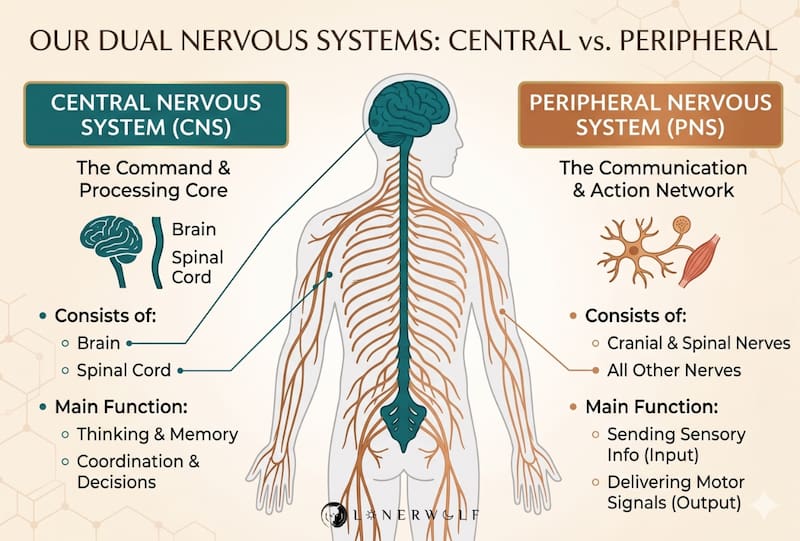
Okay! So let’s start. Your nervous system is composed of two parts:
- The central nervous system (composed of the brain and spinal cord), which controls high-level functioning like thoughts, memories, emotions, sensory information processing, reflexes, and making sense of the information sent from the next part of the nervous system:
- The peripheral nervous system (a network of nerves branching from the spinal cord) which transmits information to and from the brain to the rest of the body, monitors and adjusts the body’s homeostasis, and helps to regulate automatic physical processes like digestion and heart rate.
Here’s an image that summarizes this division:
Peripheral Vs. Somatic Nervous System
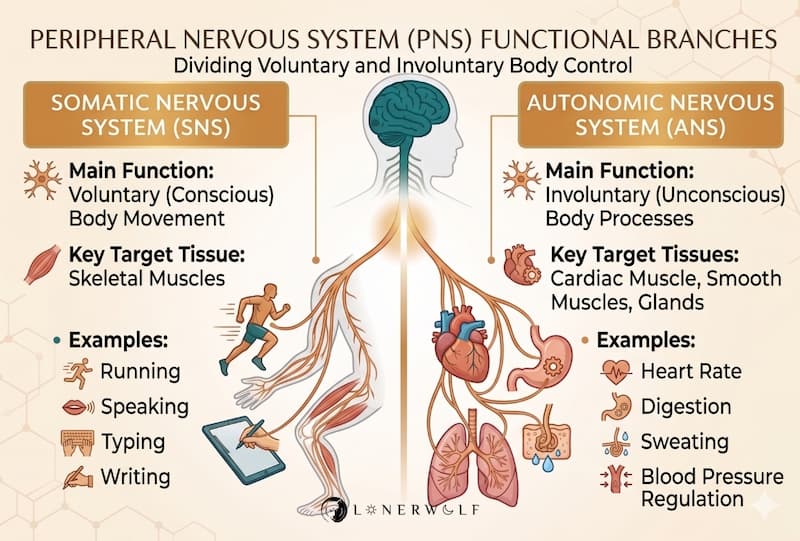
Within the peripheral nervous system, there are two branches: the somatic nervous system (which controls voluntary movements like typing, speaking, running) and the autonomic nervous system (which controls involuntary bodily processes like sweating, digesting, and heart rate).
This image depicts the difference between these two branches:
Sympathetic Vs. Parasympathetic Nervous System
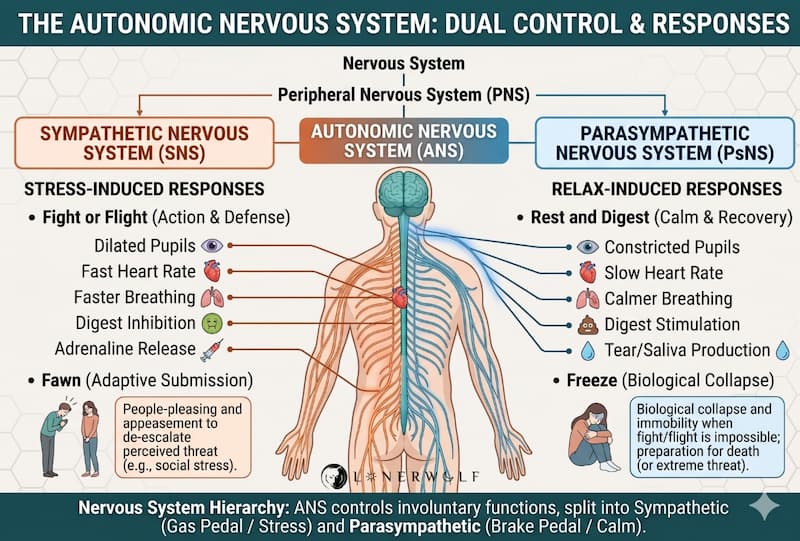
When people talk about nervous system regulation, they’re usually referring to working with the autonomic nervous system (which is connected to the peripheral nervous system, see image above), which is FURTHER divided into the following two branches (this is like the movie Inception here, folks!):
- The sympathetic nervous system – this is responsible for the stress-induced “fight or flight” response and, in more recent literature, is attributed to the “fawn” response (aka, people-pleasing)
- The parasympathetic nervous system – this is responsible for the relaxing “rest and digest” response, but also the “freeze” response (which happens when we can neither fight, flight, or fawn, and are essentially preparing for death on a biological level)
The image below depicts this essential difference:
How to Start Working With Your Nervous System (the Autonomic Ladder)
One of the most powerful models I’ve found for working with the nervous system is from neuroscientist and psychologist Dr. Stephen Porges, called the Polyvagal Theory.
Would you like to save this?
Your information will never be shared.
Developed in the early 1990s after his study of the “vagus nerve” (the longest nerve in our body that controls a lot of parasympathetic activity), his teachings have since been developed by many other professionals, including Deb Dana (who came up with the idea of the ‘autonomic ladder’).
His theory essentially says that there are multiple levels to how our nervous systems respond to the world. These form an “autonomic ladder” that moves from lack of safety to safety and vice versa:
- The ventral vagal state, which is part of our parasympathetic nervous system. This is also called the “social engagement system,” and it’s when we feel connected, safe, compassionate, and at home in ourselves and the world. Here, our heart rate is relaxed, we are open to playing and bonding with others, and we’re functioning well.
- The sympathetic state, which is connected to our parasympathetic nervous system. This is when some stressor comes into the picture and we enter a fight, flight, or fawn state. Our heart rate speeds up, we feel tense, and adrenaline rushes through us.
- The dorsal vagal state, which is a more ‘primal’ part of our parasympathetic nervous system. This is when you start shutting down from the stress if it’s too much for you mind-body to handle. Low mood, social withdrawal, and dissociation are all signs of dorsal vagal activation.
- The freeze state, which is when both the fight-flight sympathetic state and the dorsal vagal shutdown state are activated. I’ve heard this described as putting your feet on both the accelerator and brake in a car. When we cannot ‘escape’ from the stressor, we enter this mixed state. Depression, extreme fatigue, fibromyalgia, breath holding, coldness in the body, and emotional numbness are all signs of the freeze state.
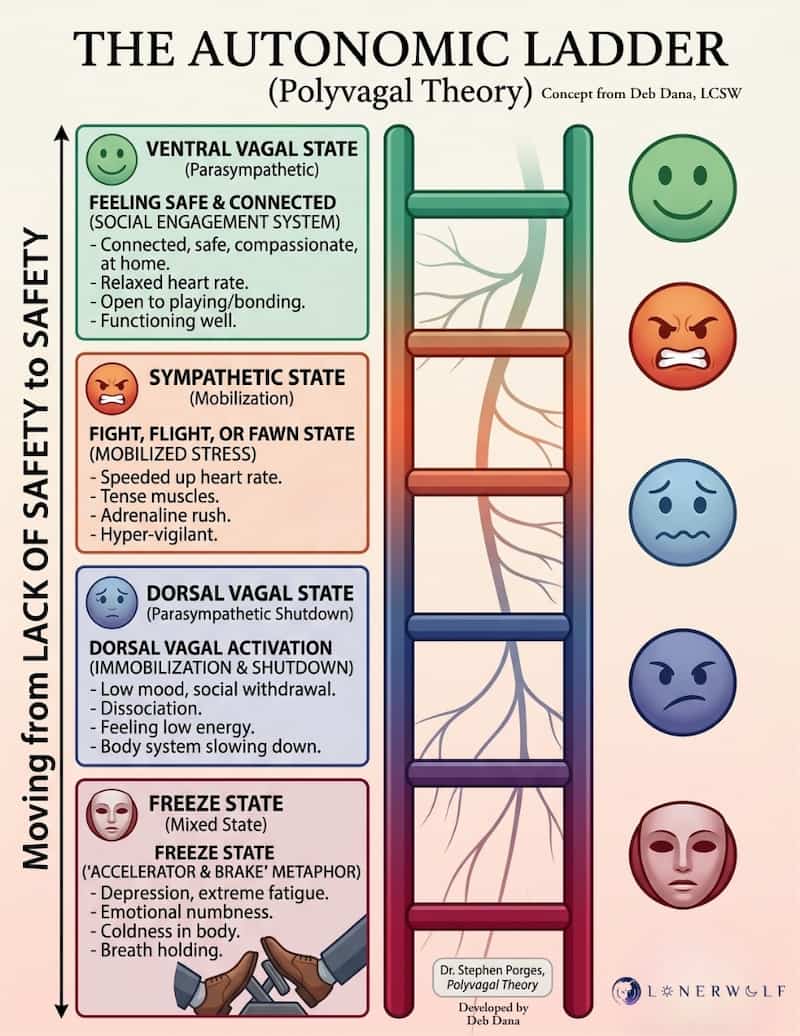
Learning how to regulate your nervous system is about getting out of the chronic freeze, dorsal vagal, and sympathetic state described above, and learning to live more in the ventral vagal (relaxed) state. It’s about flowing back and forth between all four states without getting stuck and finally returning to a baseline of calmness.
This is such a complex topic that I’ll leave it at that right now.
But NOW you know the real meaning of regulating your nervous system – it’s multi-layered! ;)
The Nervous System & Inner Work: Why You Can’t Separate Them
“Real learning can occur only in dialogue with one’s body.” — Eugene Gendlin, Focusing
Have you ever heard the expression “the issue is in the tissue”? Well, the same principle applies here.
Your unresolved traumas, shadows, wounds, and soul loss aren’t just buried in your psyche. They live within your body. They’re not just some abstract psychological concepts; they are embodied experiences that you carry with you every single day. Ultimately, the nervous system doesn’t care how much intellectual insight you have – if you aren’t addressing the body, your inner work will only go so far.
Nervous system healing or embodiment work is inseparable from inner work. It is the foundation on which this psychospiritual journey of healing begins.
Without grounding in your body and finding safety, any attempts you make at developing self-love, working with your inner child, or befriending your shadow will be undermined and eventually sabotaged. Start with the body first.
The Body IS the Unconscious
“The unconscious is the body.” – Marilyn Ferguson
I’ve written before about the unconscious and subconscious mind and how vital they are for healing and inner work. And one of the most powerful avenues to this transformational potential is through the body, as it is a direct reflection of our unconscious minds.
For over 15 years, we've strived to make this website a haven of free, valuable information. Imagine a world where this knowledge wasn't readily available.
If this post sparked a meaningful insight or helped you in any way, please consider a donation as a heartfelt "thank you" for keeping this resource free.
Every contribution, big or small, allows us to keep giving back.
 Yes, I'd Like to Help
This idea that the body is our unconscious was first popularized by psychoanalyst Wilhelm Reich back in the 1930s. Reich discovered that our muscles, gestures, and postures all reflected unconsciously stored material in the form of “body armor.”
This idea was later popularized by physician and psychotherapist Alexander Lowen in the 1970s, who believed that the body is the unconscious made visible.
The Inner Child and Shadow Speak Through the Body

Knowing that the body reflects our unconscious minds, it makes sense that our inner child and shadow would speak through our bodies.
In the words of Jennifer Mann & Karden Rabin in The Secret Language of the Body,
“Oftentimes, nervous system dysregulation is the manifestation of wounds to our developmental self or inner child.”
And in Romancing the Shadow, therapists Connie Zweig and Steve Wolf write about the shadow and body, sharing that:
“The shadow wears the camouflage of physical symptoms. We may lie, but the body does not. We may forget an abuse, but the body does not. Like shock absorbers, our bodies absorb the wear and tear of emotional experience. We may defend against it, but our bodies take the heat. And slowly, over years, the patterns of stress and trauma accumulate. Inevitably, if we do not become conscious of the shadows lodged in our muscles and cells, they begin to tell their tales. What is your body trying to say? If your cells could speak, what secrets would they reveal? What betrayals?”
It is our emotional triggers, our aches and pains, and our stress responses that are doorways into deeper embodied healing. This is, again, why inner work is inseparable from healing the nervous system. Both go hand-in-hand.
Grounding: The First Skill

“The body is anchored in the here and now while the mind travels into the past and future.” – Buddha
Learning how to ground yourself is the first foundational tool when it comes to regulating your nervous system.
Without being embodied, that is to say, connected to yourself and to earth, it is hard to do any meaningful healing work. It is impossible to recover access to our wise and wild souls.
The opposite of being grounded is being dissociated, which is a symptom of trauma.
In the words of psychiatrist and researcher Bessel Van Der Kolk in his book The Body Keeps the Score,


“…trauma makes people feel like either some body else, or like no body. In order to overcome trauma, you need help to get back in touch with your body, with your Self.”
So how do we start the work of getting grounded? Here are a few ideas:
- Learn to orient (aka, look around with gentle curiosity) and ground yourself in your environment.
- Wear comfortable and non-constricting clothes and shoes (I recently learned this!).
- Spend at least 10 minutes a day in nature (ecotherapy is a gift).
- Eat grounding foods like home-cooked meals and whole grains + root vegetables (and lay off the sugar and processed items).
- Have an exercise routine that you do at least three times a week (walking, running, weight training, etc.).
- Reduce your screen time and do grounding hobbies like gardening, creating art, or using your hands in some way.
There are many more forms of grounding out there. But start here. And if you’re in the thick of overwhelm and need something fast, try this DBT coping skill for when everything feels “too much”.
Breath as a Regulator and Anchor
“… only through breathing deeply and fully can one summon the energy for a more spirited and spiritual life.” – Alexander Lowen, Bioenergetics
After learning basic grounding skills, the next most powerful way of learning how to regulate your nervous system is through your breath.
Breath is life, spirit, and movement. Breath keeps us anchored, centered, and regulated in the present moment.
Breathe shallowly (from the chest), and you’ll feel tense, rushed, and hypervigilant. Your sympathetic fight-or-flight nervous system will be constantly activated.
However, when you breathe deeply (from the belly), you’ll feel more grounded, centered, and calm. Your parasympathetic rest-digest nervous system will come online
There are many breathwork techniques that can help you to both expel tension and relax your body. But the simplest and most effective one I have found is simply lengthening your exhale because that directly helps to slow down your heart rate so you can enter a parasympathetic resting state.
Some approaches to this long exhale technique are:
- Diaphragmatic Breathing (Belly Breathing) – inhaling through the nose and slowly exhaling through your mouth
- 4-7-8 Technique – inhale for four seconds, hold for seven seconds, exhale for eight seconds
- 2:1 Breathing – simpler than the previous method, this one involves exhaling twice as long as you breathe in (e.g., breathe in for 3 counts, exhale for 6 counts)
The Vagus Nerve: Your Body’s Reset Button

You may have heard of this curious nerve while browsing the internet.
The vagus nerve is the longest cranial nerve in the human body. It travels all the way from the brain to the stomach and helps us to relax, slow down, digest food, and connect with others and the environment around us.

Learning to ‘stimulate’ your vagus nerve is so powerful as it can help calm, restore, and ‘reset’ the body from stress.
As a simple place to start, here are some easy ways of starting to ‘activate’ your vagus nerve:
- Yawning
- Singing
- Humming
- Laughing
- Massaging
I share more approaches and a deeper exploration of this topic in my vagus nerve exercises guide.
Releasing What the Body Holds: Somatic & Physical Approaches

“The body remembers, the bones remember, the joints remember, even the little finger remembers. Memory is lodged in pictures and feelings in the cells themselves. Like a sponge filled with water, anywhere the flesh is pressed, wrung, even touched lightly, a memory may flow out in a stream.” –Clarissa Pinkola Estes, Women Who Run With the Wolves
Sometimes, when learning how to regulate the nervous system and reconnect with ourselves, merely getting grounded, breathing better, or activating the vagus nerve isn’t enough to shake the years of metastasized stress stored within our flesh.
Often, what we may need is another more hands-on modality like somatic experiencing, hakomi, myofascial release, and others that I explore in my article on somatic bodywork.
Noticing the type of muscle tension we carry can also give us a clue about how to release it. For example, if you have a lot of neck pain, perhaps you’ve put up with too many people who are “pains in the neck” before. For that, you might want to loosen the neck via yoga or do some therapeutic screaming.
If you’ve got stomach issues (maybe something you “couldn’t stomach” as a kid?), you may want to get acupuncture or change the food you eat to be more grounding, clean, or nourishing.
Creative & Expressive Regulation

‘My belief is in the blood and flesh as being wiser than the intellect. The body-unconscious is where life bubbles up in us. It is how we know that we are alive, alive to the depths of our souls and in touch somewhere with the vivid reaches of the cosmos.’ – D. H. Lawrence
If you’re a sensitive and artistic type of person, creativity is a powerful way of learning to express yourself, digest old traumas, and regulate your nervous system.
Drawing, sculpting, scrapbooking, or crafting of any kind bypasses the analytical mind and gets us into our hearts and bodies. It’s a powerful way of not just releasing emotions and processing unconscious material, but forging a mind-body connection. Putting pen to paper, using your hands to pull yarn, or molding clay brings you alive and gives the soul a voice.
These art therapy ideas can help you if you need more inspiration.
Nervous System Regulation as a Spiritual Path (Not Just a Practice)

I want to be very clear here: nervous system regulation isn’t just a novel practice. It’s not something to tack onto the end of another inner work modality. It is the foundation of all inner work.
Not only that, but the body itself can become our spiritual path. In the words of Zen master Thich Nhat Hanh in Awakening of the Heart,
“You may think somehow that being aware of your body is not an important spiritual practice, but that is not correct. Any physiological, psychological, or physical phenomenon can be a door to full realization.”
Embodied spirituality is the most authentic form of spirituality in my mind, as it is rooted in the here-and-now of our daily existence. It’s not a dissociated and disconnected spiritual idea floating around like a fart in the wind. It is felt in and expressed through the body.
When people talk about integration as a vital part of all healing and inner work, what they’re speaking about is embodying the message. Em-bodiment literally meaning: in the body.
So please know that I’m not spending hours writing this guide for the heck of it. Instead, I’m doing it because I know how essential this work is. It’s the vital first step in the journey of healing and soul recovery.
Shadow Work Journal:
⭐️⭐️⭐️⭐️⭐
"Wow! Wow! Wow! I’ve bought three books of yours so far and they’re high-quality works - and helped me so much. But the Shadow Work Journal is truly something! Right from the first exercise, a core wound of mine (deeply buried inside my shadow) was effortlessly revealed to me! Your instructions helped me go layer by layer to uncover that wound underneath my unhealthy pattern." – Maha
Uncover Your Core Wounds!
If you’d like a simple place to begin with this work, see my guide on ways to start regulating your nervous system as a sensitive person.
Conclusion: Your Body is Wise Beyond Measure
In the words of author and somatic educator Ann Weiser Cornell in her book The Power of Focusing,
“The truth is that our bodies are wise in many ways hardly ever acknowledged by our culture. Our bodies carry knowledge about how we are living our lives, about what we need to be more fully ourselves, about what we value and believe, about what has hurt us emotionally and how to heal it. Our bodies know which people around us are the ones who bring out the best in us, and which people deplete and diminish us. Our bodies know what is the right next step to bring us to more fulfilling and rewarding lives.”
Learning how to regulate your nervous system isn’t merely the best way of approaching healing from the beginning. It’s also a source of deep wisdom.
When you learn to befriend your body, you come back home to the present. You become more embodied, more ensouled, more alive.
Tell me, what state do you think you might be stuck in right now: fight, flight, freeze, or fawn? What area of nervous system healing described in this guide calls to you the most? Let me know in the comments!
If you benefited from this free guide, it would mean the world if you could buy me a coffee.
Two paths to inner transformation – here’s how I can help you go deeper:
1. The Soul Work Compass Course: Feeling lost or stuck in repetitive cycles of pain? The Soul Work Compass Course is your guide to reclaiming your true purpose. In this deep yet practical journey, you’ll learn how to heal core wounds and create a tangible "Soul's Compass" to navigate life with clarity. Enroll now and find your True North!
2. The Inner Work Journal Bundle: Ready for deep transformation? This bundle includes three powerful journals – Self-Love, Inner Child, and Shadow Work – with 150+ prompts to heal wounds, integrate your darkness, and experience bone-deep change. Digital & printable. Print unlimited times.
I love this article as I am having breathing problems . Practicing your belly breathing techniques now. Thank you so much.
Thank you so much for your beautiful insight – you are both an inspiration to me and you found me at the perfect time which was a loving gesture from the Universe.
I would like to share with you an ancient practice from Egypt and specifically from the book of Thoth.
The Ancient Deities did this on daily basis.
Walk barefoot for 20 minutes each day. With each step imagine golden roots growing from the heel of your feet extending into the permeable sand. Imagine the roots tapping into the electro-magnetism stored and provided by mother Earth. This life force energy transfers to the golden rooted soles (souls) and then travels up through your skeletal structure and its goal is to reach the spine where this energy is transferered throughout your body.
I hope that you enjoy this prctice if you havent already done so.
I am blessed that i live 5 mins from a beautiful beach.
Crosby beach, Liverpool, NW England.
Peace and Love to you both Eternal friends xxx
That is such a beautiful and unique practice, Colin. Thank you so much for sharing! I’m going to try this in my backyard today (although it’s winter here, so I’ll have to wear shoes). With gratitude 🌲
Good evening beautiful soul.
Thank you for this email this week. This has resonated with me. The nervous system is such an important part of the human person and body that we tend to forget about this as it does an important function. Please also note that when women from 50 years old they go through what is a different time. In this time they rely on the body to function as per normal, but unfortunately it has gone through a complete swing of nervous system changes, hormonal changes etc. As a person experiencing all the advise from yourselves it makes sense to listen to your body and trust the instinct, advise, intuition and guidance given.
Blessings to you both.
Sallyjane
Thanks for sharing this, Sallyjane. The body is one of our greatest sources of wisdom, so it’s a pity when people ignore or reject what it has to say.
Thank you,
Chris
Thanks Chris 💜
I think it’s noteworthy that Buddhism evolved in the following ways:
1. The earliest practices (the Hinayana) were mind oriented, focused on studying and understanding Buddhist scriptures.
2. The next development (the Mahayana) was heart oriented, with practitioners focused on becoming bodhisattvas for the benefit of all sentient beings.
3. The final development (Tantra) was BODY oriented, viewing the body as a divine microcosm of the macroeconomic Whole/Universe/Source (whatever you want to call it) and using physical practices in an effort to bridge the gap between the two (the body and the Universe) and unite them.
Oops, that was meant to be “macrocosmic” not “macroeconomic”. (🤬 autofill!)
And I should have called the final development Vajrayana. It includes Tantra, but is not identical to it. Not all Vajrayana practices are tantric, and in fact Tantra predates Buddhism itself.
But the ultimate practice is to is to use EVERYTHING in life: everything that you experience, and everything thought and emotion that you have, as an integral part of your spiritual, meditative practice. (After all, the ultimate goal IS to become “one with EVERYTHING.”😌)
Thank you both for such a superb explanation of such complicated topics. You have provided a beautifully coherent foundation that I see the importance of prioritising NOW before beginning your journal bundle which I invested in last year.
Blessings to you both and thank you for all you offer us,
Asira ✨🙏🏻
Thank you Asira 💜
Great in depth article! This particularly resonated with me when you wrote, “ Learning how to regulate your nervous system is about getting out of the chronic freeze, dorsal vagal, and sympathetic state described above, and learning to live more in the ventral vagal (relaxed) state. It’s about flowing back and forth between all four states without getting stuck and finally returning to a baseline of calmness.”
The ability to flow back and forth, between and amongst, without getting stuck or fixated anywhere applies equally to Soul moving between the physical, astral, causal, and mental bodies, while still remaining anchored in pure Soul awareness. When we are moving freely within and between the physical body as well as the emotional, memory, and thought bodies, we are on the way to becoming a free spiritual traveler, both within the body, and without…..I would liken pure Soul awareness as the calm ventral vagal relaxed state. This is our anchor as we continue to serve selflessly “being in the world (embodied), but ultimately not of it.”
“I would liken pure Soul awareness as the calm ventral vagal relaxed state” – beautiful connection you make here, Norm. The principle of flow seems to be a universal pattern and sign of health. Stagnancy and rigidity = fear and death. Flexibility = joy and life. I appreciate your insightful comment. 🌊
Thank you for this. It has really helped to pull together the knowledge that I’ve gained from various training courses over the years, including reflexology.
It also explains what happens to one of my family when they experience a shutdown, which I think will be really useful, both in terms of dealing with the situation there and then, and reflecting on it afterwards.
I would also like to say that I personally have found some of the exercises in “The Secret Language of Your Body” by Inna Segal really helpful in clearing blockages and restoring mental and emotional balance.
Thank you for all your great work – you are both a true beacon of light in what often feels like a very dark world :)
I’m so glad you find this exploration helpful, Tracy. It took so much reading, research, and direct experience to compile a guide like this, and I’m grateful it has supported someone. I actually have that book by Inna Segal on my shelf. I think I’ll go revisit it!
Thank you for reading, sharing, and being here. 💜